
Palestine has just received an upgrade in its international status at the UN, which could allow the disenfranchised state to bring legal grievances against Israel in an unprecedented way.
Like the majority of people, you probably have a hard time getting your head around the ongoing struggle between Israel and Palestine. I've spent 7 months there, have studied mid-east politics, and dialog with Palestinians, Israelis, Muslims, Jews, and internationals about it often, and I still find it very unclear at times. I find this video both instructive and clear-minded. It is fair, without compromising any core truths by equating the two peoples' situations. I'd suggest it to anyone interested in a clearer understanding of the struggle.
I should say, as well, that I appreciate any feedback on this perspective, including disagreements, especially feedback that isn't inflammatory, dogmatic, intentionally misleading, or reductive.
Read More......
Showing posts with label israeli occupation. Show all posts
Showing posts with label israeli occupation. Show all posts
Friday, November 30, 2012

Saturday, September 3, 2011
Hittin' the press: Biking In the West Bank
Urban Velo let me tell the stories of a few of my friends and provide a broader context for the Palestinian/Israeli situation. Checkit! Urban Velo's free where you can find it, to boot!

update: early response shows that while the article's good, the online reader leaves something to be desired, to whit: If the article appears to only be one page long, look for a little green arrow to the bottom right of the first page. It's actually four. I'm not letting you off that easy! Read More......
update: early response shows that while the article's good, the online reader leaves something to be desired, to whit: If the article appears to only be one page long, look for a little green arrow to the bottom right of the first page. It's actually four. I'm not letting you off that easy! Read More......
Monday, July 25, 2011
Goodbye Palestine
Time to say goodbye to Palestine.
6 months of my life have passed here, a substantial amount of time, though I'll forever be an outsider. There's no way to wind up all that has passed into a neat conclusion, the only thing to hope is that I and the people I've effected are better for it. I know I am, and I think they are.
I know it's time to say goodbye because I've more-or-less been living elsewhere in my mind for more than a month now. When I wake up in the morning I don't think about checkpoints and land grabs and settlers with guns and wedding expenses. I don't think about olive trees and being forbidden to travel by Israelis and then the PA and then your father after that.
I've been thinking about being born in poor parts of America, where the rooms are just as empty as Palestinian ones, rows of beds and an over-used kitchen. I've been thinking about women who fear to be on the street, and the women who don't fear at all. I've been thinking about the difference between street-smarts and prejudice. I've been thinking about protest art and bicycle adventures and learning to live with love and conscience in a world gone crazy. Broken systems and broken families and where the drugs come from to maintain and perpetuate those damaged networks. I've been thinking about Lulzsec, reaching up into the corruption and pulling its mask off, and dusty activist train-hoppers on the US-Mexican border. Birth control and equal rights and equal consumption and equal anything as long as it doesn't contribute to someone else's oppression. Punk rock girls with free expressions, the audacity to be pure and bold in the face of the grid.
But still, when I sit around a huge saucer of chicken, rice, pine nuts, and yogurt, with 5 or six cheery people who joke and riff about what's between us in simple ways that I've come to understand, I feel at home. And I'll miss that. I'll miss the heat, and the 8-13 year old boys practicing to be old men. Perched in a plastic chair, struck incredulous by their own exhaustion. "Shaub. Hot." And indeed it is. I'll miss stopping in random villages, under random trees, and talking shop about the number of children a given stranger has, or American politics. I'll miss infinite patience, and simple positive drive in the face of massive unfairness and inhumane conditions.
There are things I won't miss at all, but they'll be outweighed by my love of kunafe after a month or three and I know soon I'll be scheming to come back. But I also know that this isn't the only place I can be effective in this world. I'm not married exclusively to this cause. I'm married to the cause of a better human future. And that's one chain store that's always open for business.
So goodbye for now, Palestine, I'll see you down the road. If I still have air for fighting, and you still have cause to call this place your own.
Read More......
Friday, July 22, 2011
Beit Ahmad Sidi: Just another reason it sucks to be Palestinian
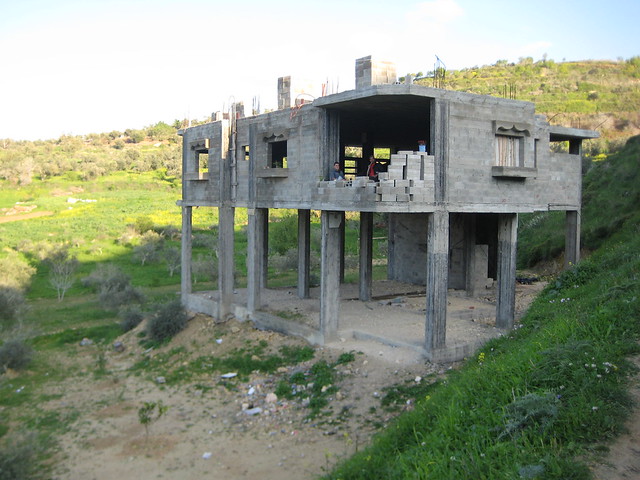
Ahmad started building his house a year and a half ago, but unfortunately it falls arbitrarily in Area C. Area C is the designation of areas completely controlled by the Israeli military, and they run contiguously throughout the west bank. Any growth or development or infrastructure planned in these areas has to be cleared with Israel, and it's usually roundly rejected.
So when Ahmad started his house he was informed that, though he owned the land, it could be demolished at a moments notice unless he got the proper paperwork. He's been trying do do so for years, going back and forth between Ramallah, shuffling papers. The village of Jit is surrounded by settlements, which cause constant problems, but Ahmad's house is far, far from them, surrounded by other palestinian developments.
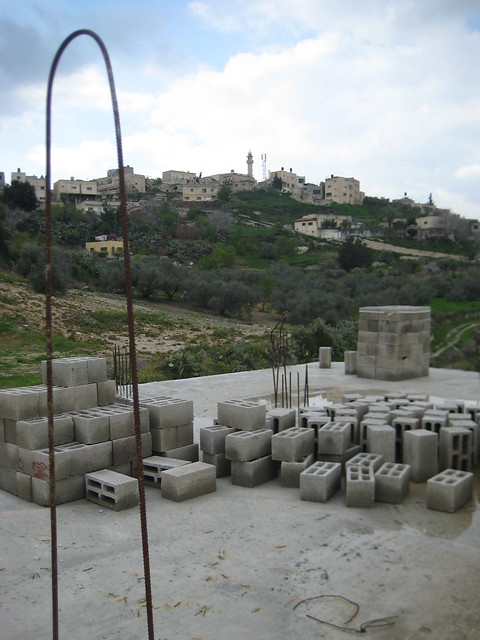
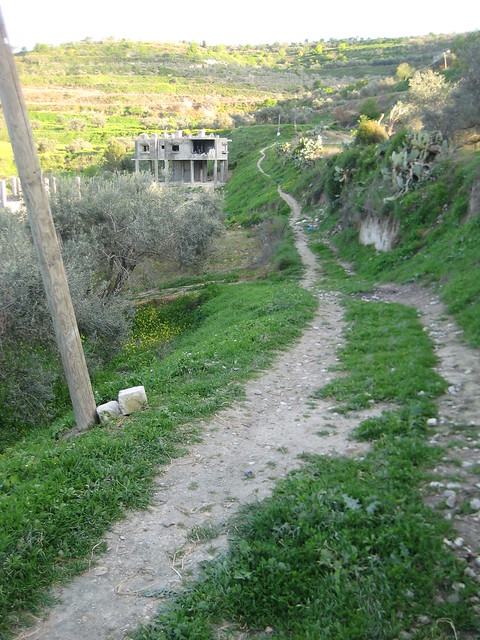
This shows the distance of his house from the rest of the village.
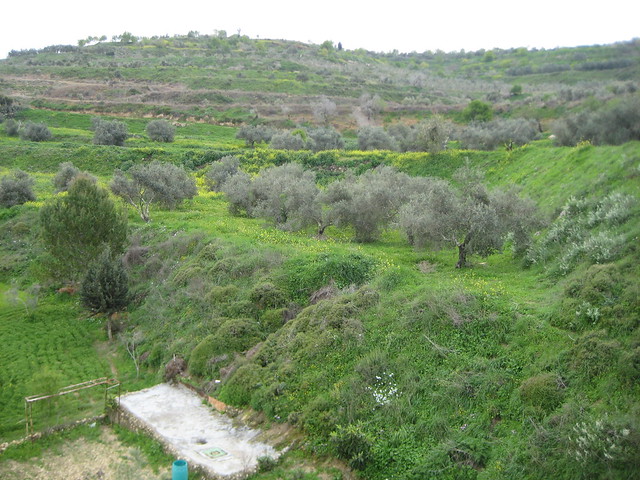
Nothing around but trees.
His plot was designated area C because it is within a mile or so of a through road used by Palestinians and settlers alike, which means Israelis get to say what happens in all the land around it.
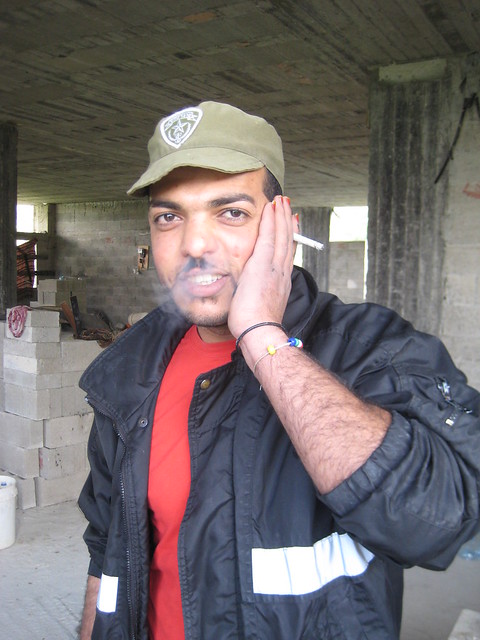
In the meantime, the house is taken care of and sometimes used as a shelter by Ra'ed, a charming and funny deaf-mute guy who does magic tricks and plays practical jokes. He camps out here and sometimes gives foreigners visiting the area a place to stay, making tea and little fires in the the shell of the house.
Ahmad's experience is just a blip, just a single case study in the face of tens of thousands of similar moves, destructions, humiliations, and pressures. On the other side of the power structure, Israel plans and builds hundreds of settlement homes, which will probably never go away, curtailing any mutual reconciliation or peace process.
Read More......
Friday, July 1, 2011
Interview with myself: Debriefing on the FAQ's of the Palestinian/Israeli Conflict
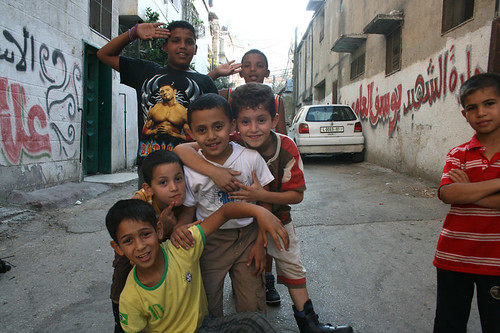
I'm not an expert anything. I'm just a guy. With a blog. Ugh. And most of the time I'm fine with that, but today I feel like I have some answers. So I got the most credible journalist I could find within ten feet of myself: me, to interview... me. I've been in Palestine five months at this point and I think a thing or two about a thing or two. Read on to see my personal take on those sound-bytey political questions we all think contain some kind of truth about the Israeli-Palestine conflict.
What is the situation on the ground in the West Bank?
It is an occupation, where an Israeli state descended from the people who took the land by force in 1948, control, by military might, all aspects of Palestinian daily and long-term existence. This means that travel between areas, building, goods exchange, resources, infrastructure, and legal and police matters are either directly under Israeli control or heavily influenced through the control of a proxy government. This means Israelis are, under international law, responsible for the human rights conditions of their occupied populations. These conditions aren't great, nor are they encouraging to any long-term development from the occupied region. Palestinians are frustrated and often subjected to collective punishment in the form of arbitrary searches and seizures, interrogations, imprisonment without due process on the individual level, and societal/systemic crimes like land grabs, farm and house demolition, barriers that geographically make life impossible for transit or agriculture, and so on.
Every day settlers and hard-line zionists take more land in the West Bank and violently
attack nearby villagers with impunity, under protection from the Israeli army. This results in the fracturing and disabling of the society at slow and unsensational rate. There is no legal recourse for these crimes, so people simply try to live a normal life and let resentment and anger build up under the surface, exhibiting astonishing patience overall. It is very safe for internationals to be in the West Bank, and most Palestinians I know hold resentment only against the occupation as a system rather than the Jewish people as a whole.
Can you address the notion of anti-semitism as it pertains to the Israeli- Palestine question? Why are you sympathetic to the Palestinian point of view?
It's an important but rather simple question. I continually remind myself in the face of the inequality and violence of the root reason I am here: To struggle for a system that is just and equal in its consideration for all people, a system that is motivated for humanitarian rather than capitalistic or militaristic ends. In this vein I fully support an Israeli desire for self-determination and the international concept of Jewish safety. What I cannot support and in fact work or advocate against is the idea that the self-determination and security of Israel can come at the direct detriment of a captive and oppressed people. In the current occupation, the long-term quality of life for Palestinians is ruined. Their ability to have agency, dignity, and respect is completely demolished in the name of Israeli security, based on motivations that are as unconscionable as they are illogical. From a humanitarian perspective I am obligated to fight this, especially because the Jewish people I know and love and talk to pride themselves on their humanitarianism, democratic outlook, and fair-mindedness. Just as from a humanitarian perspective I struggle against endemic injustice, militarism, and class violence in the United States, which theoretically prides itself on similar values. I am against the idea of 'sides' however, more on that later.
None of this is anti-semitic. Anti-semitism was a real blight and the reason we're aware of the term today is because massive atrocities in the past were suffered by the Jewish people, but at their root those atrocities were atrocious because massive groups of people were systematically imprisoned, oppressed, and killed under rampant nationalism and militarism. I resist the manifestations of those things in my time, which include the actions of Israel as a state and Zionism as a movement.
There's also the issue of relative injustice. Israel often justifies its actions by citing violence from Palestinians. The most fair-minded voices cite this violence as evidence of a continuing conflict between an oppressor and the oppressed, the most hawkish and hateful voices bring up racist arguments and dwell on the western misconception of Islam as inherently violent and Arabs as bloodthirsty savages. In a Post-colonial world it's not even worth dealing with these straw man arguments. But what is troubling is when Israel will kill 1,400 Palestinians in Gaza over one winter with large scale explosives, flooring entire city blocks of civilian housing, in response to some randomly fired missiles which are dangerous and inhumane but a minuscule threat in comparison. I focus on the systemic root of the violence: constant militarization, not the hollow justifications for that militarization.
Speaking of that, what about the question of security for the Israeli people?
Security for any people is an important goal, as is the wonderful motivation of a life without fear. In light of these goals it is important to consider the root origins of that insecurity and where the chosen solutions are likely to lead you. One of the most sustainable ways to live without fear is to love your enemies, not in some cheesy idealistic way, but to cultivate a considerate relationship with them over generations that precludes violence and leads to a diverse, multicultural society. This may sound all cutesy in terms of the reality on the ground, but it has existed for centuries around the Holy Land and elsewhere in tolerant pockets. It's just a question of muzzling the war hounds and encouraging this kind of dialogue in the larger political discourse.
One of the most sure-fire ways to live without security and true safety is to separate yourself from what you fear and characterize it as an irrevocable lost cause. This form of prejudice doesn't solve any problems, especially when it's attached to hyper-militarism. If Israel continues to force the solution of a hyper-vigilant militarized compound as their future state, that is exactly what they will get, until they kill themselves or every Muslim around them who they (and we) have incited into violence over 100 years of otherization and colonialization. We owe it to ourselves to recognize the common ground and common future with a population that in reality is incredibly un-scary, and by-and-large patient and steeped in ideas of hospitality and peace.
In short justifying the occupation from a security perspective, or the American support of it, is a short-sighted, self-fulfilling, and destructive attitude to harbor.
What is the current relationship between Israel and America about?
America and Israel have a mirrored relationship to the Arab Middle East as they both base their approaches in defense of an exaggerated fear: which at the moment is called militant Islam, but for America it has worn many masks over the years. The root problem is that America and by extension the world economy is built on unstable capitalist practices that require resource and wage imperialism all over the globe so that the pace of modern life can continue unhindered. This imperialism takes form in the destabilization of local power in order to reap the resource benefits from a weakened and turbulent region. Also it justifies massive military spending, which puts money into the hands of extremely rich organizations and individuals and keeps the population in fear, hesitant to dissent, and chronically under-educated. America's tactics vary from place to place in these matters, but in the Middle East the foreign relations policy has been to support Israel with military aid to the tune of three billion per year (money which perpetuates an otherizing political mindset, excessive militarism, and symbiotically funnels money back into the U.S. military-industrial complex), and support governments that are open to US intervention rather than ones that encourage a representative democracy. Thus, since the foundation of Israel America has treated them as our only true ideological ally in the region, and contributed to inequality and turbulence ever since. I'm reminded of a hard-to-cite quote floating around the internet: “Every time anyone says that Israel is our only friend in the Middle East, I can’t help but think that before Israel, we had no enemies in the Middle East.”
In any case, our ardent support for Israel is was one of the main reasons we are written off by everyone in the Middle East, from Osama Bin Laden to random six-year-olds, as the enemy. Until we move this policy in the direction of true, non-Islamophobic, non-racist humanitarian aims we will make very little progress in diplomatic and civil negotiations, and our self-appointed fate will be endless militarism, violence, inequality and war. No fun.
What can Americans do who are interested in effecting change?
This is where I have to bring up the 'taking sides' thing. I'm clearly against some things, and those things include perspectives that put the security of a few at a vast premium before the human rights of many, especially when the security is an unattainable fantasy in the context of the situation that's been created. I'm also against systemic injustice, and fear as a primary motivator all across the world. At this point I'm not against a Hebrew-speaking place for Jews existing next to or in the same place as an Arabic-speaking place that's predominantly Muslim. I don't care what its name is or who's in charge of it, as long as there's a power balance and every person or culture in that region as access to freedom of expression, dignity, respect, and self-determination within the limitations of what that society can support.
Support of these goals doesn't have to manifest itself specifically toward the Israeli-Palestine conflict, there are huge areas needing work everywhere. From the post-earthquake destruction of Haiti to the failing social systems in the face of drug and gang violence in inner-city America to the brutal responses to democratic voice in Syria, Libya and Bahrain. It's important that we as a people learn as much as we can about these and other conflicts and use them constructively in the context of improving our way of existing in the world. So do what you can, where you're drawn to, and keep an open ear to the similar work being done in other venues and directions.
But as to the specific Israeli-Palestine conflict, basically, you can encourage law-makers to quit spending most of your money on militarism, war mongering, and Israeli aid (again, not because Israelis are BAD, but because there's a power imbalance and we as Americans contribute to it). But more simply you can normalize the dialogue on a understandable level, by arguing that it doesn't make sense to support Israel to the extent we do from a human rights perspective. This can take many forms. There's the Boycott, Divestment, and Sanctions campaign, which starts with consumer options (bleh, I say just live simply and don't buy crap you don't need in general, not for a political motivation alone) but goes up to policy advocacy and divestment in economic and academic arenas. You can talk to friends and family that unconditionally support Israel and dispel them of unfair or unjust notions with evidence. Or you can come to Palestine and suffer near-death by over-feeding while meeting people, thinking and writing, and doing volunteer work with community-reflective locally-informed projects.
If you're Jewish, however, whoa boy do you have a job to do. Because you're already miles ahead of the rest of us in the lazy public-dialogue scale of credible sources. People will listen, American people will listen, American POLITICIANS will listen if you speak out against crimes against humanity being perpetrated in the Jewish state. Also because whether you like it or not, you're attached to those crazy Zionists in Israel! They're doing things in your name, every day, strapping on M-16's and allowing settlers to assault people in broad daylight in the name of a Jewish homeland. Just like my government has spent the last ten years systematically bombing the Middle East in my name, for the sake of American freedom. So if it bothers you to be conflated with those people because of a common ancestry and common religion, speak out! Change the paradigm! Because unless you represent yourself, they'll continue to represent you.
Feel free to re-post this or share it anywhere if it's of interest to you, just let me know in the comments section. Also if the comments happen to take a turn towards the way public internet comments sometimes do (i.e. knee-jerk ad hominem attacks and obfuscating rants that don't actually address the claims of the article) I'll consider deleting them.
Read More......
Monday, June 27, 2011
Men in Nablus
I borrowed a Canon DSLR from my buddy Julia in order to snap some shots of Ibrahim for an article I'm working on. It was such a pleasure to have a decent camera, I felt like I could suddenly speak again! Don't leave home without one. On my way to the shoot I familiarized myself with the camera by grabbing some shots of friends along the way. Regarding the title, you'll notice 'Men' is right. The public realm in general and foreigners snoopin' around with cameras certainly don't play nice with Middle Eastern Women. But to all my women friends, I want a picture of you too!
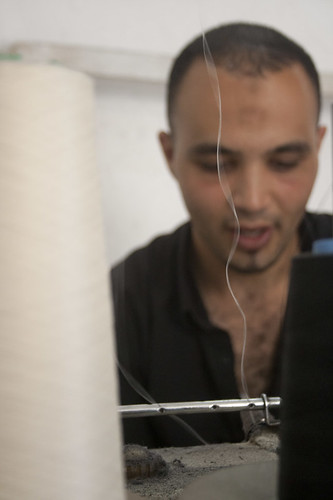
Here's Ameed at work. He's always bugging me to stop and chat at his sewing shop, and is always mad cos' I'm always busy.
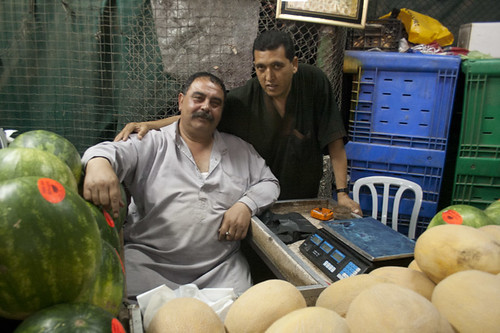
Two Husseins. The one on the left is a santa-clausy character that's always jokin' with me like I'm a local. I went with my friend to his stand once and my friend was like 'that guy insulted you like 100 times!' Whatever. I can't tell. The other Hussein is both a football coach and art teacher in Askar. He speaks arabic CRAZY fast and I'm really stoked when I can understand him.
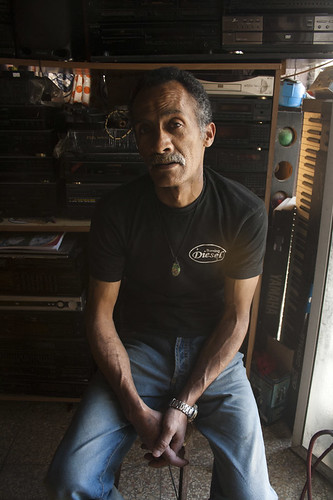
This sweetie's named Baseem, he's a toothless guy who lurks in a picturesqely hidden coffee shop over the old city, rooms randomly filled with electronics. He knocked his teeth out on a scooter a couple years back so he talks with a funny lisp. Photos of his brother, Basim, pepper the old city, as he was a resistance fighter who was gunned down in his sleep by Israeli forces in 2007. I think I know most of this family and we talk all the time about politics, it's amazing that they'll treat me as a friend considering the US's justifiable rep around here.
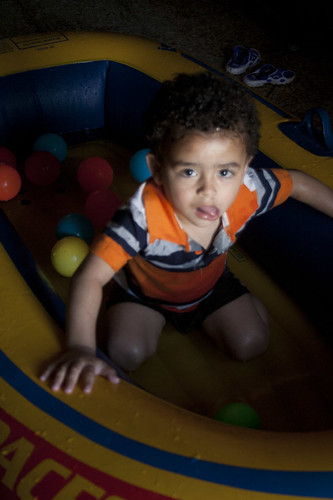
Here's his son, Basim, named after his uncle. Baseem's an older fella who only wants 2 kids, which is super strange in Palestine. Cool guy.
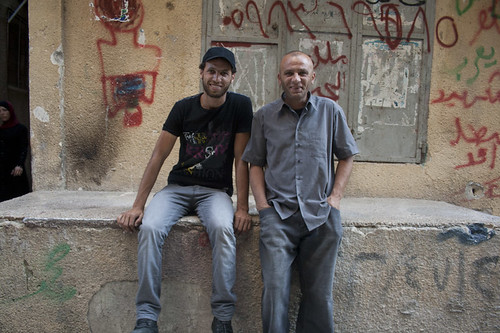
After a photoshoot in the old city Ibrahim and I went to Balata, here he is with his brother.
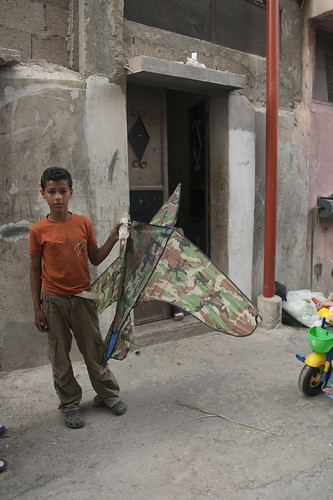
Boy with Kite, Balata Camp
I was shooting Ibrahim for a bike article, but somehow horses got involved. Go figure.
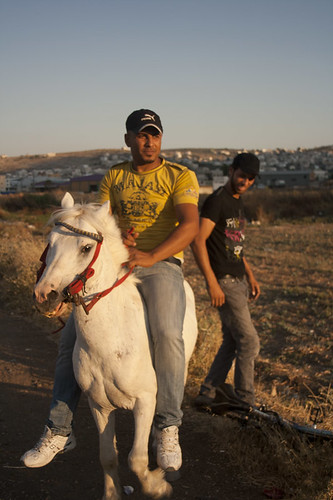
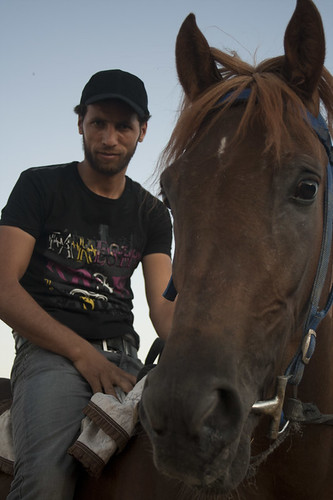
The best shots (obviously!) are the ones I'm using for the article, but there are like 20 good ones, so maybe I'll throw them up here so ya'll can help me decide which ones to use. Good to be back in Nablus, good to have a good camera.
Read More......
Here's Ameed at work. He's always bugging me to stop and chat at his sewing shop, and is always mad cos' I'm always busy.
Two Husseins. The one on the left is a santa-clausy character that's always jokin' with me like I'm a local. I went with my friend to his stand once and my friend was like 'that guy insulted you like 100 times!' Whatever. I can't tell. The other Hussein is both a football coach and art teacher in Askar. He speaks arabic CRAZY fast and I'm really stoked when I can understand him.
This sweetie's named Baseem, he's a toothless guy who lurks in a picturesqely hidden coffee shop over the old city, rooms randomly filled with electronics. He knocked his teeth out on a scooter a couple years back so he talks with a funny lisp. Photos of his brother, Basim, pepper the old city, as he was a resistance fighter who was gunned down in his sleep by Israeli forces in 2007. I think I know most of this family and we talk all the time about politics, it's amazing that they'll treat me as a friend considering the US's justifiable rep around here.
Here's his son, Basim, named after his uncle. Baseem's an older fella who only wants 2 kids, which is super strange in Palestine. Cool guy.
After a photoshoot in the old city Ibrahim and I went to Balata, here he is with his brother.
Boy with Kite, Balata Camp
I was shooting Ibrahim for a bike article, but somehow horses got involved. Go figure.
The best shots (obviously!) are the ones I'm using for the article, but there are like 20 good ones, so maybe I'll throw them up here so ya'll can help me decide which ones to use. Good to be back in Nablus, good to have a good camera.
Read More......
Tuesday, June 7, 2011
In the press: Bike Palestine!

While I'm still sitting around with my finger in my nose trying to think of a good way to document my crazy experience volunteer guiding bikers through the West Bank, Olivia Snaije (that's her on the left!) got it all together in this nice, leveling piece in Haaretz, aimed at reminding Israel of the humanity and approachability of their oft-demonized neighbors. She also gave me a paragraph-long shout out that makes me sound cooler than I actually am.
Between Warm and Fuzzy, and Dangerous Read More......
Abraham's Path: Walking the Other Face of Palestine
API: Walking the Other Face of Palestine (2011) from One Light Cinema on Vimeo.
I love this video for Abraham's Path.
Firstly, walking across Palestine, and the greater Middle East, is a beautifully simple action and way of investing in the situation that matches the frankness and honestness with which Palestinians accept their visitors. I think the people who would sign up for such an endeavor are hardy and patient, good representatives of their culture, and the people they meet along the way would teach them many things about Palestine.
Secondly, the local organization which Abraham's path works with for logistics and connecting with guides, the Siraj Center, is excellent. Their people are fun and strong and frank and know the landscape politically and geographically through and through. The worked with us on the Bike Palestine trip and were the saving grace to an otherwise hilariously dysfunctional experience.
Thirdly, the filmmaker's a consummate pro, and pulled a light and luster out of the Palestinian spring that I envy. He also had the temerity to get close-up shots with people in the villages and streets, men and women, which speaks legions to his fluency in the culture and ability to communicate with people.
I want to do work like this.
The one criticism I have of this short film is the gloved-approach they take towards one of the main facets of Palestine: the occupation. I've gone along the route they took, by bicycle, and I know for a fact the tourists I was with learned profoundly from the contrast of villager kindness and simplicity and the restrictions and difficulties they face with their militarized neighbors in the settlements. In the film Hebron, a city nearly destroyed by the prison-like conditions the tension between settlers and locals create, is intentionally glossed over as a normal place, when in fact the tomb of Abraham is divisively pivotal to the city's situation: it is because of the tomb that settlers are so fiercely dug in there. It makes sense that Abraham's Path would omit this, as to them Abraham is a symbol of the uniting aspects the 3 religions of the book share. This is their goal: to dwell and uphold the commonalities that make us human as a path towards peace rather than be divided by our differences. But once someone comes to Palestine they learn undeniably that there is an imbalanced power structure to the division, and the conditions are slowly choking off the future of the people here. To omit this reality in pursuing a dialog towards common ground and peace seems confused, or ineffective, or capitulatory, to me.
But everyone who's spent some time thinking about the conflict here already knows this, and since everyone else is constantly imbedded in the negative aspects it's nice to see and beautiful, hopeful film. I just hope they're being hopeful in the name of progress, and not to avoid stepping on powerful toes. Read More......
Saturday, June 4, 2011
Refusing to Leave, or Leaving all the time.
An excellent episode of Radiolab talked about cities, their behaviors as organisms (growing, breathing, many units making up a whole, product in, product out) but their weirdly unique characteristic of never dying. Around here, where occupiers and cultures come and go to the tune of 7000, 10000 year histories (Jericho, anyone?), it's clear that where people dig in there heels it takes quite the circumstance to get them to leave. Radiolab gives the amazing example of Centraila, a little podunk town in Pennsylvania that was home to an underground coal fire for years, people factionalizing and bickering and never wanting to leave, the ground under their feet literally burning. People fought tooth and nail to stay there. When asked to explain why they held on so long, experts simply chalk it up to human nature. The primal desire to hold onto what you know, to what's yours.
So of course, when you're Palestinian, and someone says, "hey, leave!" you say "hell no!" And everyone knows what happened from there. A century long push-pull, mostly pushing, of new neighbors greeted with hospitality and co-existence to a tenuous balance under a mutual occupier to armed struggle and aggression and mutual conflict to the ever diminishing tracts of crowded, occupied, and strangled land under a militant, victorious, zealous foreign government. Und so weiter.
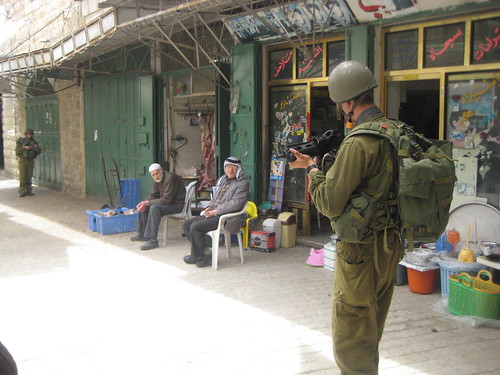
The very core of the tragedy, from a sustained humanitarian suffering perspective, is that Palestine was not destroyed quickly. It's currently halfway through an era-long strangulation, which, as the imagery suggests, isn't pretty. Couple that with the spiky, unnatural settlement compounds multiplying all over like torturous barbs, and the land starts to appear as some kind of BDSM victim. Sure, some might find that sort of thing quite cool, but I must remind everyone that a key difference between serial rape and an adventurous relationship are the issues of violence and consent.
Wow. So now kink is a metaphor for Palestine. I'm SO going to hell. Moving beyond that...
In short, the people are primally and inextricably obligated to resist the destruction of their homeland. But like the Radiolab guys mention, cities don't die, they just change hands. I think also of Istanbul, that many-named city, where buildings like the Aya Sophia were once sites of pagan rituals, then roman temples, then churches, then mosques, now 'theological monuments.' We're watching that kind of spatial-cultural takeover happen in real time. Ask an Israeli about their cultural food. Shakshouka? Felafel? Hummus (Hummus wars?)? as Arab as the hijab. Or, my favorite example, the Mid-East floor squeegee/mop:
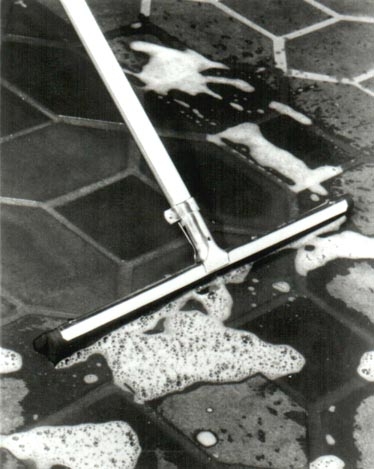
This humble device is an ingenious method of cleaning floors, and both my Israeli and Palestinian friends have championed it as an invention of their culture, going so far as to suggest we open a business selling them, usually at the same time as deriding this:

as a unilaterally inferior way of cleaning the crap off the floor. As the American in Palestine I'm resigned to a healthy dose of anti-American cultural ribbing, but hey, if you're going to criticize, at least do it with things you don't share with your sworn enemy. But that's just it. These two cultures are and have been more similar than dissimilar, from their food to their hygiene to their religious customs. Remember that throw-away comment on hijabs? It's not like Muslims have a corner on the obscured hair market. Sometimes there's room for cultural mixing, where the two peoples create a hybrid existence that is rich and varied, but when the two are kept in constant inequality, one a militarized occupier and the other a powerless, voiceless prisoner, such possibilities are no more than a nice idea. Until the power balance is shifted Palestinians are just an oppressed people who
will.
not.
leave.
their.
homeland.
Now, as I'm in a retrospective vein, it's with a slightly heavy heart that I turn to where I grew up. I'm from, factually, not arguably, one of the most beautiful places on earth. It's boggling how amazing Sundance is.


This picturesque landscape raised me, trained me, gave me my desires, opinions, prejudices. I had no fear of the forest night, and knew I could walk with friends in the streets unmolested and sleep wherever we wished once night adventures wore down at 3 in the morning. We skied every day. Salt Lake, as well, is an escape from rural Sundance, and also my home. It too has never mistreated me. Yet if you told me I had to live there for the next 10 years I would probably mutiny. I have been traveling all my life and constantly running away from Utah. When I return to the states it is imperative to my plans that I move to Chicago or the Bay Area as soon as possible.
Clearly I'm from a radically different environment. Through the comfort and security afforded me by my privilege I have only the slightest qualms about abandoning my land, primarily because I know I will probably always be able to return. Palestinians, obliteratingly obviously, do not have that privilege. Their land has been threatened for close to a hundred years, and resistance is their existence. Some days I see what's happening in Palestine and I want it to die, everyone packing up and moving to the margins or wherever fate takes them, so that the suffering ends, people can have closure, and have lives concerned with something beyond the conflict.
But in reality I want to see more justice than that.
Read More......
So of course, when you're Palestinian, and someone says, "hey, leave!" you say "hell no!" And everyone knows what happened from there. A century long push-pull, mostly pushing, of new neighbors greeted with hospitality and co-existence to a tenuous balance under a mutual occupier to armed struggle and aggression and mutual conflict to the ever diminishing tracts of crowded, occupied, and strangled land under a militant, victorious, zealous foreign government. Und so weiter.
The very core of the tragedy, from a sustained humanitarian suffering perspective, is that Palestine was not destroyed quickly. It's currently halfway through an era-long strangulation, which, as the imagery suggests, isn't pretty. Couple that with the spiky, unnatural settlement compounds multiplying all over like torturous barbs, and the land starts to appear as some kind of BDSM victim. Sure, some might find that sort of thing quite cool, but I must remind everyone that a key difference between serial rape and an adventurous relationship are the issues of violence and consent.
Wow. So now kink is a metaphor for Palestine. I'm SO going to hell. Moving beyond that...
In short, the people are primally and inextricably obligated to resist the destruction of their homeland. But like the Radiolab guys mention, cities don't die, they just change hands. I think also of Istanbul, that many-named city, where buildings like the Aya Sophia were once sites of pagan rituals, then roman temples, then churches, then mosques, now 'theological monuments.' We're watching that kind of spatial-cultural takeover happen in real time. Ask an Israeli about their cultural food. Shakshouka? Felafel? Hummus (Hummus wars?)? as Arab as the hijab. Or, my favorite example, the Mid-East floor squeegee/mop:
This humble device is an ingenious method of cleaning floors, and both my Israeli and Palestinian friends have championed it as an invention of their culture, going so far as to suggest we open a business selling them, usually at the same time as deriding this:
as a unilaterally inferior way of cleaning the crap off the floor. As the American in Palestine I'm resigned to a healthy dose of anti-American cultural ribbing, but hey, if you're going to criticize, at least do it with things you don't share with your sworn enemy. But that's just it. These two cultures are and have been more similar than dissimilar, from their food to their hygiene to their religious customs. Remember that throw-away comment on hijabs? It's not like Muslims have a corner on the obscured hair market. Sometimes there's room for cultural mixing, where the two peoples create a hybrid existence that is rich and varied, but when the two are kept in constant inequality, one a militarized occupier and the other a powerless, voiceless prisoner, such possibilities are no more than a nice idea. Until the power balance is shifted Palestinians are just an oppressed people who
will.
not.
leave.
their.
homeland.
Now, as I'm in a retrospective vein, it's with a slightly heavy heart that I turn to where I grew up. I'm from, factually, not arguably, one of the most beautiful places on earth. It's boggling how amazing Sundance is.


This picturesque landscape raised me, trained me, gave me my desires, opinions, prejudices. I had no fear of the forest night, and knew I could walk with friends in the streets unmolested and sleep wherever we wished once night adventures wore down at 3 in the morning. We skied every day. Salt Lake, as well, is an escape from rural Sundance, and also my home. It too has never mistreated me. Yet if you told me I had to live there for the next 10 years I would probably mutiny. I have been traveling all my life and constantly running away from Utah. When I return to the states it is imperative to my plans that I move to Chicago or the Bay Area as soon as possible.
Clearly I'm from a radically different environment. Through the comfort and security afforded me by my privilege I have only the slightest qualms about abandoning my land, primarily because I know I will probably always be able to return. Palestinians, obliteratingly obviously, do not have that privilege. Their land has been threatened for close to a hundred years, and resistance is their existence. Some days I see what's happening in Palestine and I want it to die, everyone packing up and moving to the margins or wherever fate takes them, so that the suffering ends, people can have closure, and have lives concerned with something beyond the conflict.
But in reality I want to see more justice than that.
Read More......
Saturday, April 16, 2011
Nablus: End of Teaching with Project Hope

Leaving Project Hope today to parts unknown to the north. Well, I guess they're known, there's nothing particularly mystifying about a name like "Hadad Tourism Village," but still, I'm heading out on my bike with all my worldly possessions beneath me and I must say that sounds rather excellent! The day before I visited my friends in Jeet Village, biking there I felt tense for the first time about my situation as a foreigner on the roads here. I look 100x more like a settler than a Palestinian, and Jeet is surrounded by settlements. I definitely raise some suspicion when I roll up in a conservative village and start asking questions about the nearby geography. Also, more than a few of the settlers have a reputation of international-hassling ("Keep your nose out of my divinely inspired
Now, nearly 3 months after arriving in Palestine, I thought it time to talk about my teaching experience here. I was hesitant to give reports along the way, as my daily impressions were fluctuating wildly, one week I would be frazzled, ready to give up and the next I would be totally rewarded and invested and generally feeling hopeful for the planet. Looking back, It's hard to keep a handle on all the passed in that time, but like most good things it was incredibly harrowing, rewarding, validating, and made me grow incredibly.
The first month of classes was adjustment. I've mentioned before that as a generally busy person I've never been so busy as I was here, and I think that still holds true for the first half of my teaching position. It was a combination of having SO much to learn, having so many projects and ideas and potential ways to contribute, having a packed schedule, and working with an organization that has about 15 centers to juggle at once and as many volunteers with rotating schedules and varying levels of competence on all sides. Here's an excerpt from 1/21/11:
"Busy, so busy time compresses my head and a day of teaching is an adrenaline rush. Literally back to back meetings, classes, ad-hoc language lessons, sneaking in arabic study and lesson preparation, answering emails, all day, 6 am to 8 pm, go go go. I've never been so busy, which is saying quite a lot. The idea of traditional teaching, once a challenge in and of itself, now seems a cakewalk. How simple to communicate in your own language, in the same place, not everywhere in a city at once as I now am. In 10 minutes I teach a two hour long lesson to ESL college students, a demanding class, their english is good enough to get them in trouble. Then quickly across the entire city by foot and by taxi to Askar camp, where we teach with nothing, trying the wrangle some attention. Then video work, making a blog worth watching, building a critical mass of focus on the country. Justifying the work. Then a presentation, then, maybe, a chance to learn, reflect. Every minute's full."
Some challenges were a result of different priorities and understandings. Project Hope is first and foremost a language center, which is what Palestine needs most and what they're equipped to teach. I didn't want to teach english, but I quickly learned that unless I had some organizational clout behind me and a pretty solid amount of time with each group kids weren't terribly interested in learning about making films. The kids in the refugee camps are balancing a crazy schedule of preparing for exams, taking exams, and resting from exams. I know Islam is a religion of one god, but the fatalism with which people defer things because of rain and examinations makes me wonder if these two subjects don't command the weight and power of animist deities. Just kidding. But the fact of the matter is kids want to run around a be kids and play football and wrestle each other when they're not being subjected to a top-down education.
Things kept changing, changing, changing. My class in Askar started as an English class, an hour long. I shadowed the volunteer before me and witnessed the group of refugee kids devolve into a literally screaming mass before my eyes. The classroom setting was similar to this one:
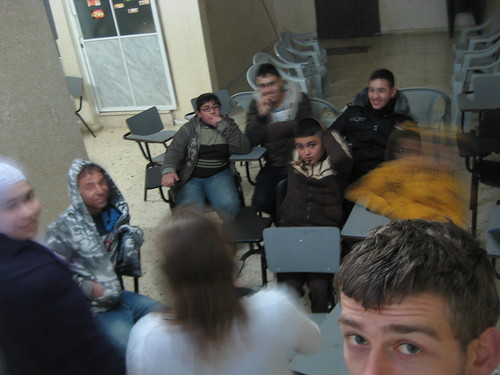
The next month was spent building trust with them, getting them on board with the idea that if they wanted to learn something fun and creative they'd have to work together to keep the class focused and the disruptive kids in check. We worked on art, photography, and English, and they never screamed or jumped on the desks with me like that first day. Sometimes 13 kids would come, sometimes 4. Then, after a very successful field trip, just as we were starting into film, things fell apart. It took them 45 minutes to do something my other film group had down in 15. I didn't trust them with the cameras, so we took them away. Selma, my co-teacher, said they didn't seem to be getting anything out of the film classes, and we might as well switch to English, and I agreed. When I told the kids that our attempts to do something fun and different had failed, and we would learn English from now on, they didn't flinch for a second. A boisterous, obnoxious girl who suddenly appeared a few times ago simply said she wanted to do English anyway. I told her that I knew she wouldn't behave or pay attention, I'd seen her previous behavior, she shrugged and said she'd be better next time, which is what she always said. The next time we went there were only 2 students there, and we decided to call it off.
In the meantime I was teaching English classes at every level of competence and working on independent film tutoring and projects. I was losing faith in the idea that cameras could be used for anything more than visual aids in learning other subjects, but at the same time I'd hear or learn about other projects that sounded wildly professional and successful, Cinema Jenin or Tomorrow's Youth Organization. It was frustrating. Then I had the opportunity to teach a 6 class film course at the Happy Childhood Center in Balata. It wasn't ideal, as cramming as much material as possible into a 2 week course wouldn't give the students the autonomy and self-empowerment needed to keep their projects up after I left. But it was better than nothing, so I went into it full force. It turned out great. Of the group of 10-12 kids 3 boys and one girl were really keen on the film projects, and two of the boys have wanted to continue working together. We filmed around the camp in a number of fun exercises and made a few good first videos. Monsour and Nayef were the most motivated, they made the contact and scheduled this interview about a house that was demolished by Israeli soldiers:
Then they made this little piece on the day a prisoner was released and talked to him:
The girls took pictures and made a sildeshow of the difficulties children face in the camp, especially girls. We talked a lot about the challenges they had even finding girls to film because all of the spaces in the street are for boys:
The more involved I was in film, the less I sweated the details in the English classes, but they turned out pretty well as well, as I was getting more comfortable with my students, the material, and teaching in general. I tried to keep things focused on discussion and grammar, as the students here are generally quite advanced in terms of vocabulary but never speak or speak timidly, so we did a lot of confidence building stuff. Those classes got to the point that I was well liked and respected by my students and they even threw me a big party with the director of education and an amazing plaque at the Islamic school, which was more than a little absurd.

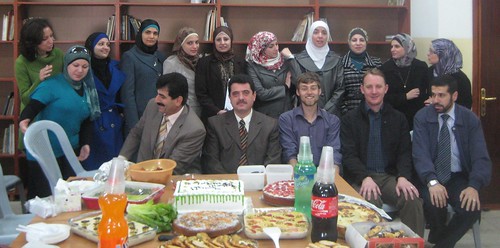
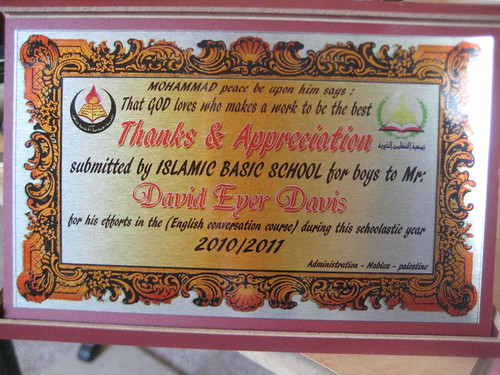
Toward the end of things I felt a really good balance between my film interest and my ability to be useful as an English first language speaker. There are some things that shouldn't be taught through translation, like editing, blogging, and computer skills. But at other times kids took the film stuff and ran with it, last week concluded another Balata 3 week course that went great in every respect, the kids doing photo scavenger hunts, writing scripts, and producing scenes even though we only had a short time together.
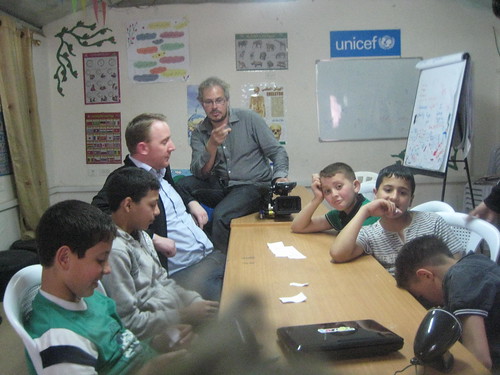
They got to see how to take their videos and put them on youtube and after I added them as my friend on facebook they got excited about the idea of showing me their future creations. Here's their first little scene, about neighbors who are so cramped they start to argue when one accidentally throws trash out his window at the others:
On the documentary front we made a little scene illustrating the inadequate spaces kids have to play. They got one of their friends who is a good as soccer to play in a narrow alley, and the narration talks about the challenges they face in the refugee camp. Then we decided to fool around and film some soccer commentary, which turned out pretty great:
Now that I'm done, part of me feels totally comfortable with this, with the fluctuating attendance, missed translations, and faulty equipment. Towards the end if I showed up to a class and my co-teacher couldn't come I'd just plow on through in crappy Arabic and teach the courses by myself, and they'd turn out great. But when I think about what I want to do next here, and people say, 'oh there's a job opportunity teaching English in X organization', I say, "Hell no!" Looking back on these three months I realize what an invaluable opportunity it's been to volunteer with Project Hope. It gave me a perspective into the way Palestine really works culturally, politically, and logistically, and did so in a way that is locally empowering and locally led, which is really important to consider if your contribution is to be useful.
Read More......
Monday, February 21, 2011
Meet Salah: The first foray into the people of Nablus
I met Salah early in my time here in Nablus, and he immediately struck me as not only photogenic but a generally gregarious and well-spoken fellow. I quickly got along well with him and started to learn some pretty interesting facets of his personality. He seemed an ideal first ambassador to Nablus. See what you think of him!:
-Salah is a volunteer translator at Project Hope, a computer science student, a Thai Boxing instructor, National Champion of K-1 Kickboxing, a good Muslim, and a Palestinian. He really loves Nablus, and wants you to, too!
Salah's profile is the first of many features to come about Nablus, if you're here and want to hear about someone in particular let us know, or if you're from abroad and want questions about Nablus or Palestine in general addressed in film form drop us a line! Who should we profile next?-
This was a fun project to do and I'm keen to continue it. The intention is to profile a different person or aspect of Nablus every two weeks or so, depending on my schedule. Right now I'm splitting my time between a steady course load of english classes, projects like this, and intensive video workshops. I'd really like to thank Asra for lending me her camera to film with, and Project Hope of course for making my time here possible and allowing me to spend my time on alternative projects. Read More......
Subscribe to:
Posts (Atom)


