Showing posts with label archive featured. Show all posts

Thursday, December 27, 2012

Making a runaway doc hit, and other things to do after college

Jacob Seigel-Boettner’s first film project out of college, With My Own Two Wheels (WMOTW), took him to four continents in pursuit of a simple story: how the bicycle is used around the world to solve problems. With no formal distribution plan, the 45-minute film has become incredibly successful, screening continuously since its creation in 2010, bringing international attention to the five bike initiatives that it features. Jacob chatted with us about the challenges of international film work, documentary filmmaking in education, and his current projects.

DD: Where did you film and how did those spots come about?

Seigel-Boettner: We filmed one story in Zambia, one in Ghana, one in India, one in Guatemala and one in Southern California. I worked with Project Rwanda and I'd gone to the Interbike trade show a couple of times to represent them. That's where I found out about World Bicycle Relief (WBR), the project that we filmed in Zambia that's now all over sub-Saharan Africa, probably the biggest bike development project out there. I knew that there were probably other projects like them around the world, to find them I literally spent a month during my senior year Googling "bike project —pick a country—." I sent an introductory letter to project directors, the ones that responded narrowed down the spreadsheet a little bit more, and then sat down and looked at themes. We knew we wanted a story related to education, one related to healthcare, hopefully several relating to women's empowerment.

DD: Could you talk about any standout experiences with the different organizations? 

Seigel-Boettner: The two extremes of how we found our characters —and this is not a knock against any of the organizations we filmed with, it was a demonstration of different size NGOs. With WBR, we told them what we wanted and they literally sent us page long biographies of four different characters. They set us up with a driver and a translator and all the logistics were totally in line, and we were able to shoot all of Fred's story in like three and a half days… which was awesome for us and for them because it minimized the cost and confusion and everything just clicked really well. On the other end of the spectrum was the project we worked with in India, Ashta No Kai, another awesome project, but they are much smaller, they haven't worked with film crews before… So we were told we were going to have two to three girls to interview and we could pick which one we wanted to have be in the film. We went into their women's center and 40 girls from the local high school piled in behind us, and sat in rows in their little pink saris and uniforms, and it ended up being a mass interview with 40 giggling high-school age girls who didn't speak our language (laughs). It was one of the weirdest casting calls I've ever done as a director. Bharati, the girl who ended up making the film, she was sitting off to the side in the front row, she was making eye-contact with us the whole time, wasn't giggling or talking to her friends, and when we asked what do you want to be when you grow up, she was like 'I want to be district supervisor' and we were like 'ok I think we're good.' She's probably the most composed and articulate 14 year old I've ever met anywhere, period. 

DD: I was struck by how intimate you were able to get with your subjects, both in shot choices and into their stories. How did you get them at ease, how did you communicate cross-culturally? 

Seigel-Boettner: A lot of it, again, came down to the project. We were very clear that we wanted to have good translators whenever we could, a lot of times the translator would be someone who worked with the project before. Like our translators for Zambia, one was one of WBR’s drivers, he drives the trucks to ship all the bikes around to different distribution points and serves as a driver when they have people come to visit the project, big Zambian guy named Giff, who's hilarious. He and our other translator Preston, a local filmmaker, they both kind of acted as production assistants and were able to communicate the vision of what we wanted to Fred, and that was a really amazing opportunity because we didn't have to script out or explain what type of shots we wanted to get and he understood the story that we wanted to tell because they were able to communicate the film/storytelling medium we were trying to accomplish. We were able to skip that really awkward 'getting to know you' phase because our translators already knew the people who we were talking to pretty intimately, and that definitely allowed us to shortcut things. 

DD: I think that's easier said than done, you bridged the gap from large international institution to local fixer to film-able subject. You're stressing the fixer/local tie-in as the strongest link? 

Seigel-Boettner: Yeah, all the projects we were working with place a very strong emphasis on being run by locals. WBR was the biggest organization that we worked with, right now there's something like 70+ staff all over Africa, I think two or three of them are expats. The rest are all locals. The same thing with the other projects. We never worked with an American or European other than our initial contact and helping us figure out our logistics. Those were the kinds of projects that we wanted to highlight, too. Those are the ones that are the most successful, the ones that aren't run by foreigners. There're plenty of smart people in those countries that need to be given the opportunity. I think that the best way that we can help with our skill sets is by helping them with storytelling. That's something that a lot of non-profits unfortunately lack: a good way to tell their stories. When it comes to reaching out and telling people what you do, there's not a better way to do it then to have a short video piece that has a person talking about how it impacted them.

DD: I wanted to talk with you about the deployment of the film: Could you talk about the length and your intended distribution of it? 

Seigel-Boettner: There’re a lot of really good stories being told out there through documentary film that are about 45 minutes too long. I've seen a lot of 90-minute social justice documentaries that I thought were spot-on, there's one about skateboarding in Afghanistan called Skateistan that's amazing. But a lot of times you can condense your story and make it consumable by a wider audience, and if you're trying to tell a story that needs to get out there and be told, I think you need to consider what's going to get the most people to see it. We knew that we really wanted kids to be able to see our film, for teachers to be able to use it in the classroom. When I was growing up, the way that movies were used was as a rainy-day thing or a substitute teacher thing, they'd put in the movie and leave the classroom, then the bell rings halfway through the movie and everybody leaves. As a filmmaker that's really frustrating, because we put all this time and effort into it, and especially with documentaries it's something that can be an incredible educational tool. When it's all said and done and we're no longer traveling with the film I want it to be something where a teacher can send me an email, get a copy of the film, get a copy of the classroom companion, put it in their school library, and hopefully continue to use it over the years as part of their curriculum. 

DD: It looks like you're thinking about how to get around the issue of a film getting a lot of effort put into it and it sort of has its initial run and then disappears. In that vein, are you satisfied with how the film rolled out? 

Seigel-Boettner: Yeah! I mean (laughs) we thought we were going to do about ten screenings, it was going to be kind of cute, and then we'd all go to grad school and that would be it. Instead I spent pretty much all of last year except for two months on the road with the film. I stopped counting at like 75 screenings. It was insane. I think we're still going to be doing screenings two or three years down the road. Maybe that's just because it's a story that was at the right time and people wanted to hear it, I don't know. So we're blown away. It's really awesome but at the same time it's kind of frustrating, because I go to all these film festivals and I see all these other amazing films that for whatever reason the spark never takes off. 

DD: I hear that. I think deployment especially for docs is a huge conundrum. A segue from that question: you can answer this in a film industry context or academic context or international humanitarian perspective: What are you up to, right now? 

Seigel-Boettner: Our big project right now is our second film, which we're getting really close to finishing our rough-cut on. It's called Singletrack High, it follows six student athletes through the 2012 season in the Nor-Cal High School Mountain Bike League, looking at kids who are life-long cyclists, kids who have never ridden a mountain bike before, and looking at the benefits of keeping kids on bikes through an institutionalized program at an age when most kids get car keys and stop riding bikes. WMOTW was great in that it encouraged people to look at other uses of the bike around the world, but at a certain point a lot of the countries that we filmed in have a potential to go the way of China, where they look at us as what "developed" means, and that means switching to a car culture/car economy, and the bike gets left behind. We wanted our next movie to be something that encouraged people to practice what WMOTW was preaching. The first race of the Nor-Cal season this year had I think 550 kids racing and over 2000 people at the venue, and their pit zone was the size of a football field, it's almost becoming an institutionalized high school sport in Northern California. So that's our next project, hoping to be released in January, we're working with Specialized and the National Interscholastic Bicycling Association, we're going to do a similar but slightly more established screening tour in the spring. 

Jacob has a knack for telling stories about projects that are simple, effective, and that encourage diverse action. Expect his work in his home territory to be equally motivating. With My Own Two Wheels is available to stream for free at withmyowntwowheels.com. Keep up with Jacob and his brother Isaac’s newest project at pedalbornpictures.com. 

INTERVIEW HAS BEEN CONDENSED AND EDITED.  

Read More......

Tuesday, November 27, 2012

Bicycle Times Review: With My Own Two Wheels

As I'm putting together an interview with Jacob Seigel-Boettner, the main man behind last year's excellent film With My Own Two Wheels, I thought I should resurrect an old review I published in Bicycle Times last year. Be sure to watch Jacob's film, and stay posted for the full interview.

We know bikes. We are with them every day, know their weight after long hours around town or races in the mud, and can take them apart blindfolded. Some of us can even weld them together from quiet tubes, or have ridden them across continents and countries. But once in a while, something comes along that causes us to simultaneously re-evaluate the basics of the bicycle and fall in love with it all over again. Filmmakers Jacob and Isaac Seigel-Boettner and Ian Wexler have done exactly that in their film With My Own Two Wheels, an easy yet ambitious documentary that spans four continents and five stories about the empowering nature of the humble bicycle.

A feeling of hope pervades the film, though it showcases very serious problems. The filmmakers introduce such diverse issues as physical disability, women’s empowerment, and the AIDS epidemic, and in each case highlight a person who is enabled through their bicycle to do more in the world.

We meet Carlos of Maya Pedal, in Guatemala, who builds Frankenstein human-powered machines that make agricultural work easier. Soon after, we roll down a dirt road with Bharati and a bunch of other sari-clad Indian girls given a chance at a future in a patriarchal society because someone gave them a bike to get to school. Shot after shot is beautiful, and though the film is short, you get a sense of intimacy with each subject. The camera lingers and treats us to their routines, their ambitions, exploring rich ways of life across the globe. Pedal power links them all, as do cunning little connecting sequences of each person gathering water, early morning tooth brushing, and, luckily for us, exquisitely lit gardens and healthy blue skies.

It is a pleasure to watch, but With My Own Two Wheels is still all about informing the viewer. Now and again statistics are subtly worked into the landscape, following the characters as they ride across it. It advocates in a realistic, healthy way that is not a die-hard guilt trip. Thus a film about hard things in hard parts of the world escapes the death trap of the world-awareness genre: devolving into a condescending sob story that leaves the viewer with little plan of action or recourse.

In fact, most of the characters, far from being objects of pity, are quite enviable. Mirriam is a Ghanaian woman with a paralyzed leg who works as a mechanic. Able-bodied men come into her shop and are blown away by the fact that she’s competent. There is pure joy in the functionality of her story, the shop, the conservation of the bike resources there. It highlights her ability rather than her inability.

Of course we, the enamored wheelmen (and women), already know about the joy of two wheels. But in the context of resource scarcity and inequality, the simple power of a bike is much more evident. Access to a bike can help someone overcome disadvantage, or increase their aspirations in general, along with their quality of life. Further, the bicycle reminds viewers in the developed world that solving problems can happen on a sustainable, human scale. The simplicity, versatility and ubiquity of the machine makes applying oneself in a positive way even easier, because you need just reach out within your community and find the way to do good work that suits you. The possibilities are infinite, and With My Own Two Wheels shows us some excellent places to start. Read More......

Saturday, November 3, 2012

Hurricane Sandy: Interviews and Photos


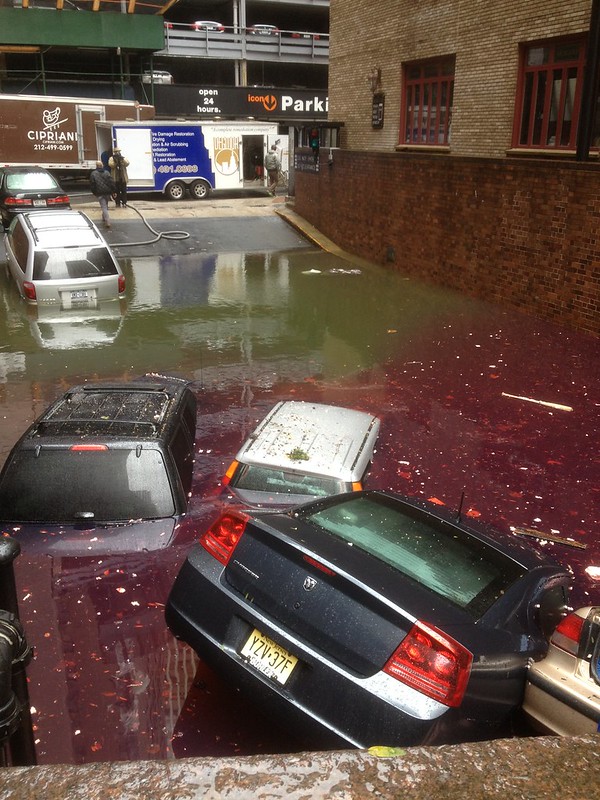
Flooded cars in a Goldman Sachs garage, Financial District.


The BBC got ahold of me for a total of 4 interviews the day after Hurricane Sandy hit New York. At that point it was mostly remarkable to me how isolated little-affected areas were from the devastation the storm visited upon their neighbors.

More photos after the jump...
The Williamsburg bridge the morning after the storm, empty.
Tossed cars in Chinatown
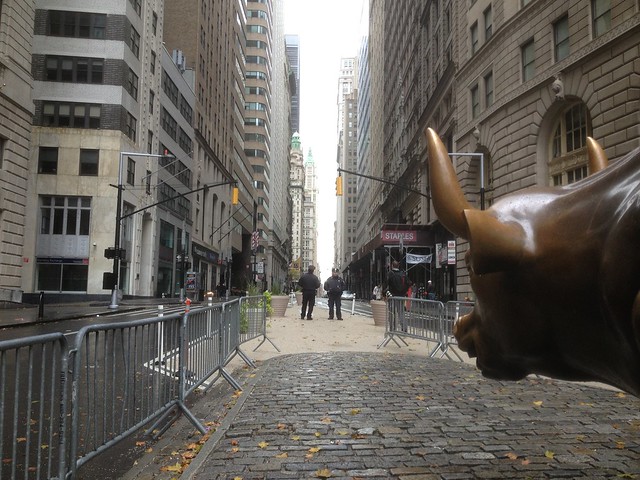
Mother Nature Occupied Wall Street.
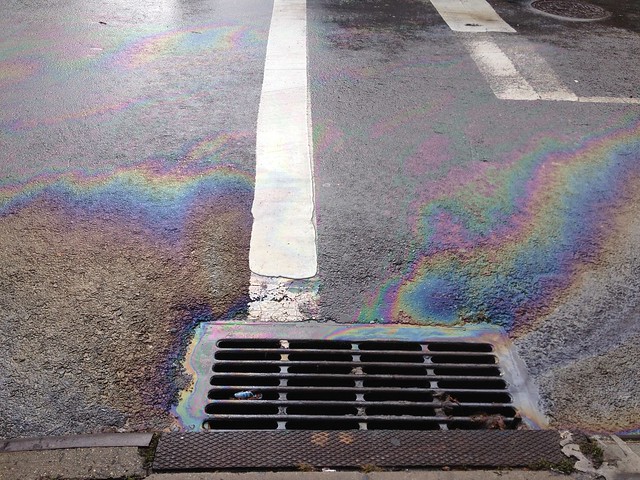
Chemicals and smells rise from underground.

A blacked-out downtown became a playground for some, a quagmire for others.
Empty Union Square, a street vendor working in the dark.

Reflecting now, it is quite frustrating to think of all the able-bodied people who were idle while those in neighboring communities of Breezy Point, the Rockaways, and the Jersey shore were in full emergency response mode. Granted, many people volunteered, and the recovery effort is continuing, but the ongoing examples of selfishness are disappointing. Equally disappointing are your average people who are unable to care for themselves in this trying time, people unwilling to walk or bike across a bridge to get back to their job, unwilling to carpool with strangers. To me it's a disheartening foreshadowing of the way the first world will react when environmental and economic situations become more severe in the future.
Read More......

Sunday, February 19, 2012

Dance, Public Space, and Public Voice


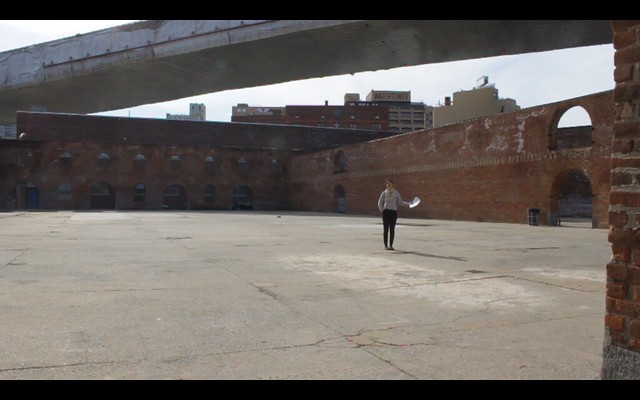
Dissent Magazine let me riff on a bit about a Girl Walk, a neat interventionist dance project, and what it means for our ongoing battle for public expression. Click the picture to take a gander. Read More......

Thursday, February 16, 2012

Reckoning with Torture Launch and Behind the Scenes


Reckoning With Torture is a creative action to bring America's recent legacy of torture under public fire. PEN American contacted me to make a few seed videos for the project, launching this week under the direction of Doug Liman. Here's his introduction, and a few examples:
Read More......

Saturday, September 3, 2011

Hittin' the press: Biking In the West Bank

Urban Velo let me tell the stories of a few of my friends and provide a broader context for the Palestinian/Israeli situation. Checkit! Urban Velo's free where you can find it, to boot!


update: early response shows that while the article's good, the online reader leaves something to be desired, to whit: If the article appears to only be one page long, look for a little green arrow to the bottom right of the first page. It's actually four. I'm not letting you off that easy! Read More......

Saturday, June 11, 2011

Coincidences don't exist.

Fine, sure they do, but they certainly help hone our lives and define what's significant. I was sitting there NOT being productive because of a wicked headache listening to Radiolab, the best show ever and apparently the generative kernel of all things inspirational to me. From this segment I learned the inspiring/heartbreaking/memento mori tale of Emily Gossiaux, a young artist from New York who was mowed down by an 18-wheeler. Emily is in the process of being re-constituted, bit by bit, from an a-sensory state. The above radiolab link is REALLY worth listening to, it floored me.

That, in and of itself, was chilling to me. As a biker, Emily's brush with death has existed in the back of my mind as a possible event for me for at least the last 8 years, whispering when I feel the most fragile. It doesn't help that this week a young lady in Salt Lake was killed in a hit-and-run, as was a bike messenger in Santa Cruz. But what really got me was her picture.

from her website.

I've seen this girl before... In my head. She's exactly what my main character looks like from a writing project I've been shelving and working on for more than a year. From my character notes:

"------ is a girl nearing college age with long dark hair and big curious eyes. Her eyes snap to a dull glaze whenever she thinks it's cooler to not be as intrigued by a given subject of interest. She discovers her alternative leanings rather than beginning with them. She's pretty, tall, and of thin build, but awkward and with a layer of slight chubbiness which causes her to be self-conscious around other girls. Further insecurity is shown in the layer of makeup that surrounds her already naturally striking eyes."

Exact. I didn't mention her eyes, but they're that color. And yeah the makeup thing's wrong, but Emily's older, she's already shed that self-consciousness. So that's creepy in and of itself. Then, a random comment, somewhere, says this girl "looks like another Emily, the Gaza Flotilla girl." Huh. Gaza. Relevant. I follow the link. Suddenly I'm learning about Emily Henochowicz, who lost her eye when bolted with a teargas canister in Qalandia a year or so ago.

They DO look alike. They could be sisters. They're both artists, and... wait... they both go to Cooper Union, and know each other! Spooky. But what's more spooky, and ever more apparent to me, is how mortal we all are. How damageable. These two girls, like so many others, were tragically cracked apart, in very different circumstances, extraordinary and ordinary, militarized occupation and routine traffic accident.

It's important to remember that every incident is a symbol for many others, a systemic whole. I hate that the world underlines and sensationalizes one death or transgression over the other. What happened to bicycle Emily could happen to anyone, and what happened to protest Emily often does happen to Palestinians.

It's actually one of the things that makes the Palestinian-Israeli conflict important to me. It's not MORE important to other things throughout the world, but the relationship of power, political manipulation in the name of self interest, and the prioritizing of oppression for gain over self-determination all can be easily transferred and applied elsewhere in the world in a thousand different contexts.

So when I watch this video, going viral at the moment, of a 19 year old American Jew being beaten and arrested by Israeli military for standing up and eloquently stating why he's against their occupation, I don't think just of him.

I think of every Palestinian who's gone through the same struggle of voicelessness in the face of injustice, and every Syrian who can't say what he believes right now, and American radicals who can't stop the destruction of the environment for wealth, and homeless kids in Tanzania who huff glue all night because they can't sleep otherwise, and then...

Well I guess then my headache comes back. Fuck. I'm gonna go live in a log cabin somewhere. Maybe finish this book. G'night everybody!
Read More......

Bye