Showing posts with label humanitarian division. Show all posts

Monday, September 26, 2011

Haiti: First Taste

Arrived. Spiraling over the islands on the flight, struck by long gouges of sandy yellow surrounding rivers, sickly veins of erosion and runoff. We may have passed over Cuba, and then through the DR side of the island, because twice I thought 'well, that looks rather idyllic and nice from up here!' Not so. As we approach Port Au Prince the verdant agricultural developments give way to the panicky, metallic sprawl of tin houses and teeming congregations of people. The busy debris of poverty.

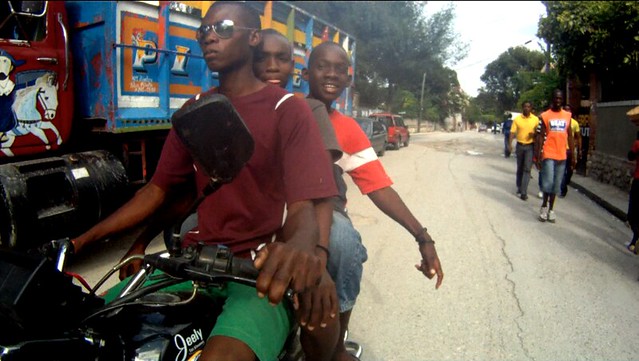
The streets don't exist. They're like jeeping trails, filled with people, women with coolers balanced on their heads. Later we get a Moto ride and I think my driver's new, he keeps just ramming people's arms and legs out of the way, which irritates but doesn't unduly enrage them. My first film plan is borne off of this ride. The idea is to get some kids to act as hosts by moto ride. They'll formally, grandly welcome the audience to the open air cinema experience, going through town as if they were royalty, as if they were the mayor. Thanks for having us, Mr. mayor...
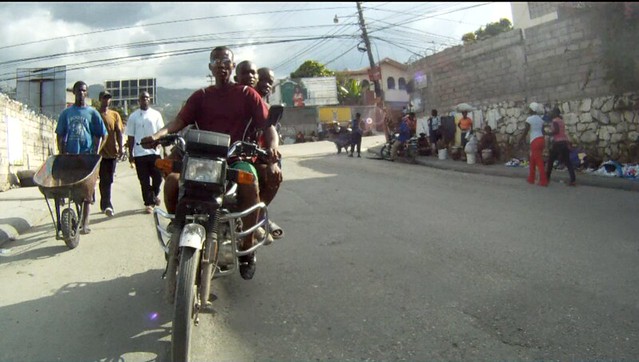
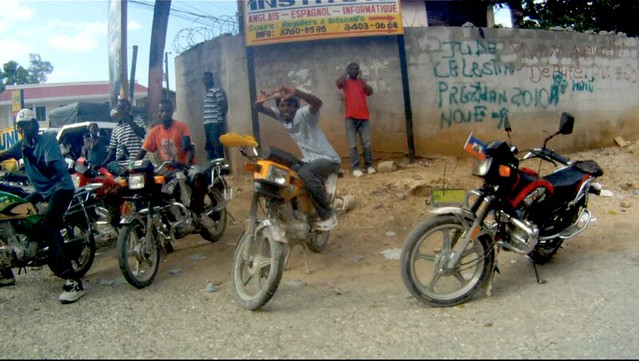


It's a rough place, so crowded and broken. People have a good energy about them, smiling and saying 'ca va?' goes a long way, but they're hungry and hot and poor and the whole aspect of being a white guy here, even with good intentions, seems tired, colonialist, and wrong. I represent money, and a continued power structure, my camera is shorthand for exploitation, and I don't have a whole lot to offer in the way of a different narrative. I'm going to continue to do the best work I can here, and I've already done some great stuff, but man, it doesn't feel right.

We essentially employ the 2 little kids in the video as child servants. They're orphans, or estranged from their family for some reason, a trio living in a smoky hut together. I didn't know this when I decided they'd be good video hosts for our screening, so I approached them to see if they had the afternoon free to make a little welcoming video consisting of the group of us roaring around on motos and yelling at each other. They had a great time, and so did I, afterward they asked for some money, as everyone does here. "Souple Davi, m' hungry, merci." 'Little shits, I thought we were buds!' I remarked to myself, and gave them each a princely sum of a dollar. Later that evening I found out they bought soup with my money, that they literally survive off of the patches of money we throw them for errands, washing, etc. That straightened me out pretty quick.

The NGO workers frequent this neighborhood, they've got their own institutions and grocery stores and roar around self-importantly in big SUV's over the 4x4 courses that pretend to be roads. I'm extremely weird, because I dress well, but make eye contact and greet people and stop to shake hands, etc. Most all the other white folks scurry around like scared little mice, or stay detached from the squalor with glasses and cell phones. I think the thing that troubles me most about the NGO presence is it maintains a normal race-and-class dynamic, here, of all places, in the land of slave revolutions. Resourceless, edged out of self-sufficiency by the mechanics of agribusiness and overpopulation, and in the hurricane/earthquake test course, these guys can't catch a break. I have many acquaintances here that came from the US, hustlers and dealers in the states, destined to always be second-class citizens there because of their race and environment. At least here everyone's on the same destroyed playing field, though people still use money to draw lines in the sand like crazy.

My bones are tired from a lack of understanding.
Read More......

Saturday, September 3, 2011

Hittin' the press: Biking In the West Bank

Urban Velo let me tell the stories of a few of my friends and provide a broader context for the Palestinian/Israeli situation. Checkit! Urban Velo's free where you can find it, to boot!


update: early response shows that while the article's good, the online reader leaves something to be desired, to whit: If the article appears to only be one page long, look for a little green arrow to the bottom right of the first page. It's actually four. I'm not letting you off that easy! Read More......

Monday, July 25, 2011

Goodbye Palestine

Time to say goodbye to Palestine.
6 months of my life have passed here, a substantial amount of time, though I'll forever be an outsider. There's no way to wind up all that has passed into a neat conclusion, the only thing to hope is that I and the people I've effected are better for it. I know I am, and I think they are.

I know it's time to say goodbye because I've more-or-less been living elsewhere in my mind for more than a month now. When I wake up in the morning I don't think about checkpoints and land grabs and settlers with guns and wedding expenses. I don't think about olive trees and being forbidden to travel by Israelis and then the PA and then your father after that.

I've been thinking about being born in poor parts of America, where the rooms are just as empty as Palestinian ones, rows of beds and an over-used kitchen. I've been thinking about women who fear to be on the street, and the women who don't fear at all. I've been thinking about the difference between street-smarts and prejudice. I've been thinking about protest art and bicycle adventures and learning to live with love and conscience in a world gone crazy. Broken systems and broken families and where the drugs come from to maintain and perpetuate those damaged networks. I've been thinking about Lulzsec, reaching up into the corruption and pulling its mask off, and dusty activist train-hoppers on the US-Mexican border. Birth control and equal rights and equal consumption and equal anything as long as it doesn't contribute to someone else's oppression. Punk rock girls with free expressions, the audacity to be pure and bold in the face of the grid.

But still, when I sit around a huge saucer of chicken, rice, pine nuts, and yogurt, with 5 or six cheery people who joke and riff about what's between us in simple ways that I've come to understand, I feel at home. And I'll miss that. I'll miss the heat, and the 8-13 year old boys practicing to be old men. Perched in a plastic chair, struck incredulous by their own exhaustion. "Shaub. Hot." And indeed it is. I'll miss stopping in random villages, under random trees, and talking shop about the number of children a given stranger has, or American politics. I'll miss infinite patience, and simple positive drive in the face of massive unfairness and inhumane conditions.

There are things I won't miss at all, but they'll be outweighed by my love of kunafe after a month or three and I know soon I'll be scheming to come back. But I also know that this isn't the only place I can be effective in this world. I'm not married exclusively to this cause. I'm married to the cause of a better human future. And that's one chain store that's always open for business.

So goodbye for now, Palestine, I'll see you down the road. If I still have air for fighting, and you still have cause to call this place your own.
Read More......
Friday, July 22, 2011

Beit Ahmad Sidi: Just another reason it sucks to be Palestinian


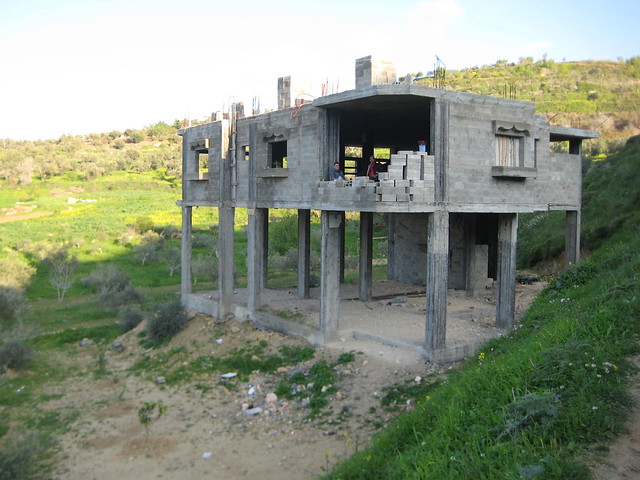
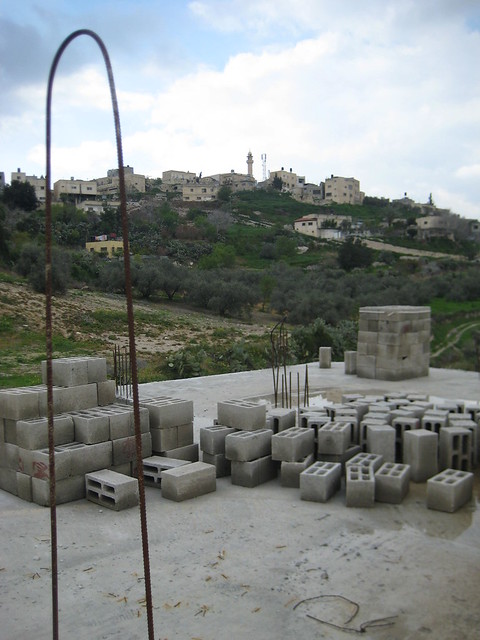
Ahmad started building his house a year and a half ago, but unfortunately it falls arbitrarily in Area C. Area C is the designation of areas completely controlled by the Israeli military, and they run contiguously throughout the west bank. Any growth or development or infrastructure planned in these areas has to be cleared with Israel, and it's usually roundly rejected.
So when Ahmad started his house he was informed that, though he owned the land, it could be demolished at a moments notice unless he got the proper paperwork. He's been trying do do so for years, going back and forth between Ramallah, shuffling papers. The village of Jit is surrounded by settlements, which cause constant problems, but Ahmad's house is far, far from them, surrounded by other palestinian developments.


This shows the distance of his house from the rest of the village.


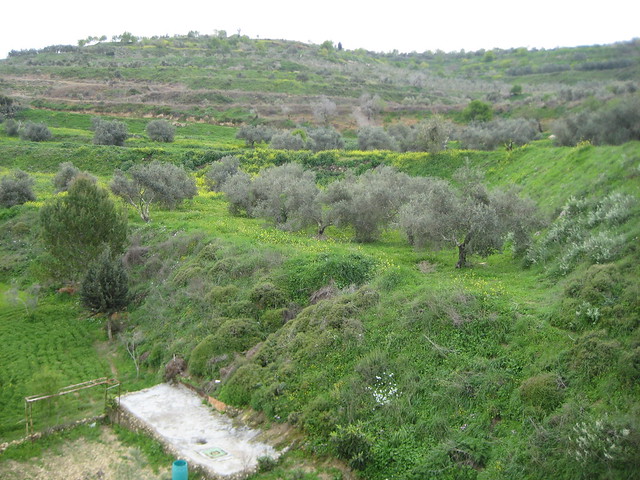
Nothing around but trees.

His plot was designated area C because it is within a mile or so of a through road used by Palestinians and settlers alike, which means Israelis get to say what happens in all the land around it.

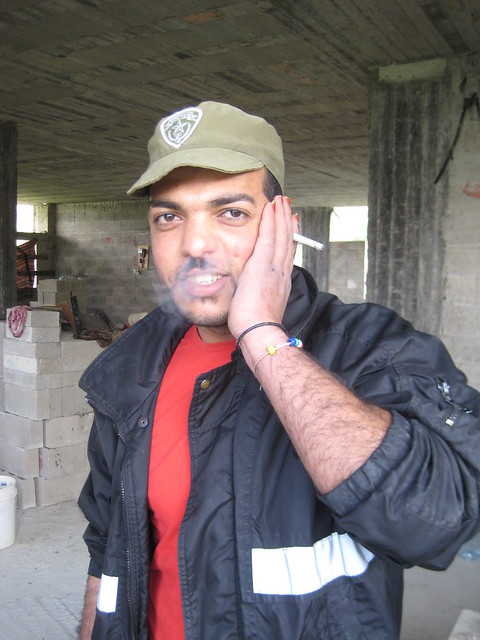
In the meantime, the house is taken care of and sometimes used as a shelter by Ra'ed, a charming and funny deaf-mute guy who does magic tricks and plays practical jokes. He camps out here and sometimes gives foreigners visiting the area a place to stay, making tea and little fires in the the shell of the house.


Ahmad's experience is just a blip, just a single case study in the face of tens of thousands of similar moves, destructions, humiliations, and pressures. On the other side of the power structure, Israel plans and builds hundreds of settlement homes, which will probably never go away, curtailing any mutual reconciliation or peace process.

Read More......
Friday, July 1, 2011

Interview with myself: Debriefing on the FAQ's of the Palestinian/Israeli Conflict


I'm not an expert anything. I'm just a guy. With a blog. Ugh. And most of the time I'm fine with that, but today I feel like I have some answers. So I got the most credible journalist I could find within ten feet of myself: me, to interview... me. I've been in Palestine five months at this point and I think a thing or two about a thing or two. Read on to see my personal take on those sound-bytey political questions we all think contain some kind of truth about the Israeli-Palestine conflict.

What is the situation on the ground in the West Bank?
It is an occupation, where an Israeli state descended from the people who took the land by force in 1948, control, by military might, all aspects of Palestinian daily and long-term existence. This means that travel between areas, building, goods exchange, resources, infrastructure, and legal and police matters are either directly under Israeli control or heavily influenced through the control of a proxy government. This means Israelis are, under international law, responsible for the human rights conditions of their occupied populations. These conditions aren't great, nor are they encouraging to any long-term development from the occupied region. Palestinians are frustrated and often subjected to collective punishment in the form of arbitrary searches and seizures, interrogations, imprisonment without due process on the individual level, and societal/systemic crimes like land grabs, farm and house demolition, barriers that geographically make life impossible for transit or agriculture, and so on.

Every day settlers and hard-line zionists take more land in the West Bank and violently
attack nearby villagers with impunity, under protection from the Israeli army. This results in the fracturing and disabling of the society at slow and unsensational rate. There is no legal recourse for these crimes, so people simply try to live a normal life and let resentment and anger build up under the surface, exhibiting astonishing patience overall. It is very safe for internationals to be in the West Bank, and most Palestinians I know hold resentment only against the occupation as a system rather than the Jewish people as a whole.

Can you address the notion of anti-semitism as it pertains to the Israeli- Palestine question? Why are you sympathetic to the Palestinian point of view?
It's an important but rather simple question. I continually remind myself in the face of the inequality and violence of the root reason I am here: To struggle for a system that is just and equal in its consideration for all people, a system that is motivated for humanitarian rather than capitalistic or militaristic ends. In this vein I fully support an Israeli desire for self-determination and the international concept of Jewish safety. What I cannot support and in fact work or advocate against is the idea that the self-determination and security of Israel can come at the direct detriment of a captive and oppressed people. In the current occupation, the long-term quality of life for Palestinians is ruined. Their ability to have agency, dignity, and respect is completely demolished in the name of Israeli security, based on motivations that are as unconscionable as they are illogical. From a humanitarian perspective I am obligated to fight this, especially because the Jewish people I know and love and talk to pride themselves on their humanitarianism, democratic outlook, and fair-mindedness. Just as from a humanitarian perspective I struggle against endemic injustice, militarism, and class violence in the United States, which theoretically prides itself on similar values. I am against the idea of 'sides' however, more on that later.

None of this is anti-semitic. Anti-semitism was a real blight and the reason we're aware of the term today is because massive atrocities in the past were suffered by the Jewish people, but at their root those atrocities were atrocious because massive groups of people were systematically imprisoned, oppressed, and killed under rampant nationalism and militarism. I resist the manifestations of those things in my time, which include the actions of Israel as a state and Zionism as a movement.

There's also the issue of relative injustice. Israel often justifies its actions by citing violence from Palestinians. The most fair-minded voices cite this violence as evidence of a continuing conflict between an oppressor and the oppressed, the most hawkish and hateful voices bring up racist arguments and dwell on the western misconception of Islam as inherently violent and Arabs as bloodthirsty savages. In a Post-colonial world it's not even worth dealing with these straw man arguments. But what is troubling is when Israel will kill 1,400 Palestinians in Gaza over one winter with large scale explosives, flooring entire city blocks of civilian housing, in response to some randomly fired missiles which are dangerous and inhumane but a minuscule threat in comparison. I focus on the systemic root of the violence: constant militarization, not the hollow justifications for that militarization.

Speaking of that, what about the question of security for the Israeli people?
Security for any people is an important goal, as is the wonderful motivation of a life without fear. In light of these goals it is important to consider the root origins of that insecurity and where the chosen solutions are likely to lead you. One of the most sustainable ways to live without fear is to love your enemies, not in some cheesy idealistic way, but to cultivate a considerate relationship with them over generations that precludes violence and leads to a diverse, multicultural society. This may sound all cutesy in terms of the reality on the ground, but it has existed for centuries around the Holy Land and elsewhere in tolerant pockets. It's just a question of muzzling the war hounds and encouraging this kind of dialogue in the larger political discourse.

One of the most sure-fire ways to live without security and true safety is to separate yourself from what you fear and characterize it as an irrevocable lost cause. This form of prejudice doesn't solve any problems, especially when it's attached to hyper-militarism. If Israel continues to force the solution of a hyper-vigilant militarized compound as their future state, that is exactly what they will get, until they kill themselves or every Muslim around them who they (and we) have incited into violence over 100 years of otherization and colonialization. We owe it to ourselves to recognize the common ground and common future with a population that in reality is incredibly un-scary, and by-and-large patient and steeped in ideas of hospitality and peace.

In short justifying the occupation from a security perspective, or the American support of it, is a short-sighted, self-fulfilling, and destructive attitude to harbor.

What is the current relationship between Israel and America about?
America and Israel have a mirrored relationship to the Arab Middle East as they both base their approaches in defense of an exaggerated fear: which at the moment is called militant Islam, but for America it has worn many masks over the years. The root problem is that America and by extension the world economy is built on unstable capitalist practices that require resource and wage imperialism all over the globe so that the pace of modern life can continue unhindered. This imperialism takes form in the destabilization of local power in order to reap the resource benefits from a weakened and turbulent region. Also it justifies massive military spending, which puts money into the hands of extremely rich organizations and individuals and keeps the population in fear, hesitant to dissent, and chronically under-educated. America's tactics vary from place to place in these matters, but in the Middle East the foreign relations policy has been to support Israel with military aid to the tune of three billion per year (money which perpetuates an otherizing political mindset, excessive militarism, and symbiotically funnels money back into the U.S. military-industrial complex), and support governments that are open to US intervention rather than ones that encourage a representative democracy. Thus, since the foundation of Israel America has treated them as our only true ideological ally in the region, and contributed to inequality and turbulence ever since. I'm reminded of a hard-to-cite quote floating around the internet: “Every time anyone says that Israel is our only friend in the Middle East, I can’t help but think that before Israel, we had no enemies in the Middle East.”

In any case, our ardent support for Israel is was one of the main reasons we are written off by everyone in the Middle East, from Osama Bin Laden to random six-year-olds, as the enemy. Until we move this policy in the direction of true, non-Islamophobic, non-racist humanitarian aims we will make very little progress in diplomatic and civil negotiations, and our self-appointed fate will be endless militarism, violence, inequality and war. No fun.

What can Americans do who are interested in effecting change?
This is where I have to bring up the 'taking sides' thing. I'm clearly against some things, and those things include perspectives that put the security of a few at a vast premium before the human rights of many, especially when the security is an unattainable fantasy in the context of the situation that's been created. I'm also against systemic injustice, and fear as a primary motivator all across the world. At this point I'm not against a Hebrew-speaking place for Jews existing next to or in the same place as an Arabic-speaking place that's predominantly Muslim. I don't care what its name is or who's in charge of it, as long as there's a power balance and every person or culture in that region as access to freedom of expression, dignity, respect, and self-determination within the limitations of what that society can support.

Support of these goals doesn't have to manifest itself specifically toward the Israeli-Palestine conflict, there are huge areas needing work everywhere. From the post-earthquake destruction of Haiti to the failing social systems in the face of drug and gang violence in inner-city America to the brutal responses to democratic voice in Syria, Libya and Bahrain. It's important that we as a people learn as much as we can about these and other conflicts and use them constructively in the context of improving our way of existing in the world. So do what you can, where you're drawn to, and keep an open ear to the similar work being done in other venues and directions.

But as to the specific Israeli-Palestine conflict, basically, you can encourage law-makers to quit spending most of your money on militarism, war mongering, and Israeli aid (again, not because Israelis are BAD, but because there's a power imbalance and we as Americans contribute to it). But more simply you can normalize the dialogue on a understandable level, by arguing that it doesn't make sense to support Israel to the extent we do from a human rights perspective. This can take many forms. There's the Boycott, Divestment, and Sanctions campaign, which starts with consumer options (bleh, I say just live simply and don't buy crap you don't need in general, not for a political motivation alone) but goes up to policy advocacy and divestment in economic and academic arenas. You can talk to friends and family that unconditionally support Israel and dispel them of unfair or unjust notions with evidence. Or you can come to Palestine and suffer near-death by over-feeding while meeting people, thinking and writing, and doing volunteer work with community-reflective locally-informed projects.

If you're Jewish, however, whoa boy do you have a job to do. Because you're already miles ahead of the rest of us in the lazy public-dialogue scale of credible sources. People will listen, American people will listen, American POLITICIANS will listen if you speak out against crimes against humanity being perpetrated in the Jewish state. Also because whether you like it or not, you're attached to those crazy Zionists in Israel! They're doing things in your name, every day, strapping on M-16's and allowing settlers to assault people in broad daylight in the name of a Jewish homeland. Just like my government has spent the last ten years systematically bombing the Middle East in my name, for the sake of American freedom. So if it bothers you to be conflated with those people because of a common ancestry and common religion, speak out! Change the paradigm! Because unless you represent yourself, they'll continue to represent you.

Feel free to re-post this or share it anywhere if it's of interest to you, just let me know in the comments section. Also if the comments happen to take a turn towards the way public internet comments sometimes do (i.e. knee-jerk ad hominem attacks and obfuscating rants that don't actually address the claims of the article) I'll consider deleting them.
Read More......
Friday, June 24, 2011

Days in the Life, Bike touring Nablus to Haifa and the places in between


I had about a week to burn with nothing to do between film projects, so I abandoned my cabin-fever inducing routine of waking at 6 and running, writing for 2 hours, bumming around, then studying Arabic for 3 more. It's incredibly productive use of my time but it makes me antsy and sometimes I run out of inspiration. So I packed up my bike and headed out for a circular 5 day route from Nablus to Haifa and back. The route would cross 3 Israeli checkpoints and take me from the most conservative points of Palestine to the most liberal points of Israel in under 4 hours of biking. The checkpoint guards tell me I'm crazy (as usual), crazy for riding a bike, crazy for sleeping in Nablus, for trusting Arabs. The only crazy thing is how little they know about their neighbors, who would kill you by earnest hospitality a whole lot faster than by any direct attack.

They let me through and I bike up a steep grade past Ariel settlement, stop again at checkpoint #2, more security, had to dis-assemble my bike to get it through a baggage scanner, but my story was more plausible this time: I had just biked to Ariel and was headed back to Tel Aviv because I like biking up mountains. After that it was flying downhill, and I was relaxing in an immaculately-maintained park on a riverside straight out of Munich or Paris by 10:00 am.

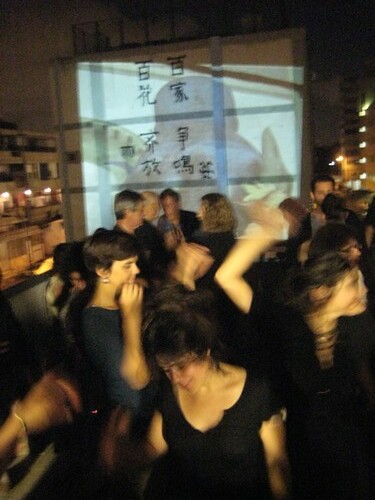
I went to Yoav's art opening in a brand-spankin' new hip gallery, white and bauhausy, 3 stories, rooftop dance patio, projected video onto the graffiti'd industrial buildings nearby. 50's ballads and mo-town all night long! Yoav's piece looked great, everyone there serious and beautiful in that academic liberal Jewish way we artists know so well.


The gallery was the brainchild of two people who had died before it could come into being. How did they die? one from cancer, one from a Palestinian Terrorist Attack (acronym pending). Damn. Those moments of connection and clarity really chill you. The artsy folks around me didn't know that the night before I was hanging out in Nablus, learning about yet another extraordinary death or collective punishment or circumstance that wasn't part of my reality from people that saw the gallery-owners death as a form of justified resistance. And I'm sitting here looking at a-political creative objects and a bunch of people having a good weekend night thinking 'how is this stuff even related?'


After a couple days of Tel Aviv I start biking up the coast to Haifa. Yoav decides to come with me, and together we set off on a funny journey punctuated by getting lost, heat, and 3 flat tires in a row. We spent the night on the beach, sleeping in sheets in the sand, listening to the ocean, and set off further north the next day.


I was planning on sleeping on the beach again once I got to Haifa, but called an acquaintance who was out of town, he was nice enough to give me his place for as long as I felt like it! So I plunked down in an old stone building sandwiched between the train line and the sea, typing away in my underwear like I've been here for months. Hilarious. My host Jeremy is really interesting and cool for someone I don't know at all. I met him in Nablus and literally talked with him for 10 minutes. He's an inventor and patent lawyer. Judging from my surroundings he knows how to cook well. One of 3 rooms in the house is taken up by an electrical workshop, there are high-powered magnets lying around everywhere, and books on basic particle physics and electrical engineering. I watched a creepy/obscure David Lynch films and read myself to bed with Stephen Hawking's A Brief History of Time. Life's good and hilarious.

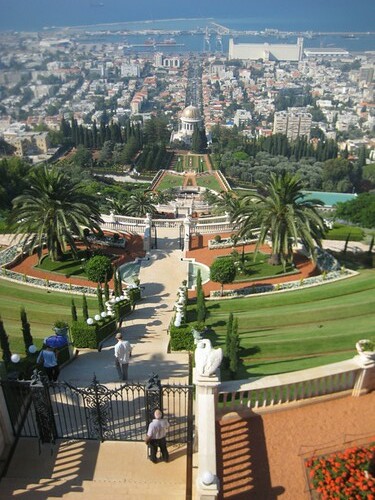
After Haifa, seeing the Baha'i gardens and hanging out with a cool woman from Salt Lake, I got my bike all outfitted as a perfect MTB tourer (which you can read me geek out about on Saltcycle). It's official now, I have a bike I like, I don't want to leave. Simple as that. The slick tires are comparatively crazy fast and touring's effortless. The Baha'i guys are pretty ideal, I talked for one about religion for a long time, they're basically Secular Humanists with a god fixation. Awesome. They believe in gender equality and compulsory education and interrelation between all people. Sign me up. They also believe in something called Progressive Revelation , which is pretty sensible. It's essentially the notion that all religious teachings throughout history were catered towards the people of that age and what they were capable of working on, in a cultural and social framework that they understand, and so on. So like 'hey bible, you're cool, but a teensy bit sexist...' type of logic going on. As a mythologist I can dig that too.


Crazy descending gardens.

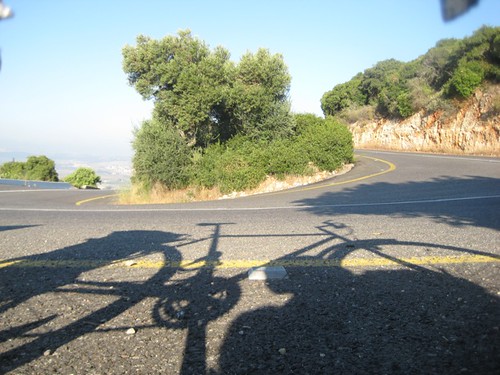
When it was time to leave Haifa I decided it was time to do some serious exploring. Without a map and with a list of village names I set off into the wilderness, and onto some of the best touring roads I've ever discovered.


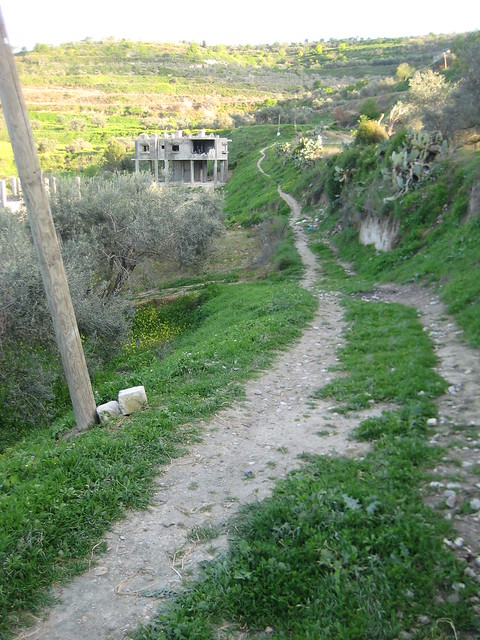
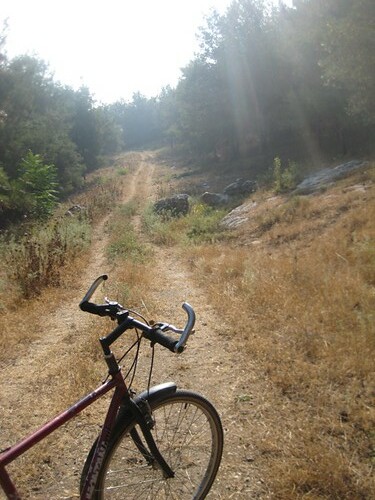
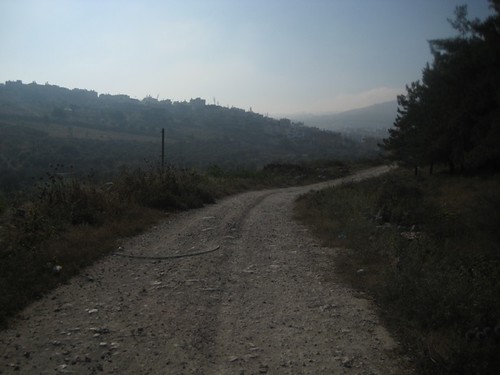
I was guided primarily by a random paragraph I found on the internet (that I can't find now, go figure) and google maps satellite pictures. I found the connection between a Jewish town and a cool little Muslim village called Ilut by looking at the satelite image and saying to myself 'I bet there's a logging road by that treeline.' After a morning's riding to the end of a random housing development, I dropped off a ledge and pulled my bike through about 20 yards of forest, to where this road emerged:


followed by this one:


and then the town of Ilut! Where the water is gratifyingly cold and the hills steep enough to encourage existentialism in pretty much anyone.


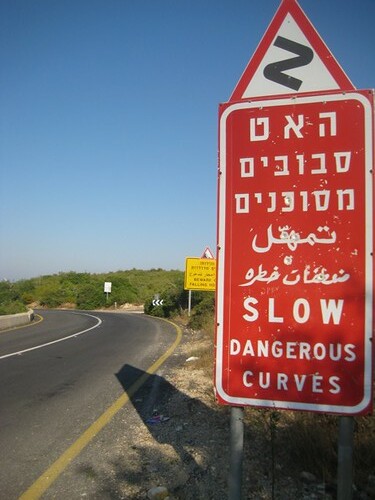
Success. From there I rode what seemed an impossibly long stretch from Nazareth to Nablus, punctuated by an improbably high number of motorcycle-like hairpin curves and the summer sun, scuttling from shade to shade like a spider, resting for half an hour at a time and chatting with various folks on the road.

The whole loop was about 300 kilometers (186 miles) and spanned a whole lot of Israel/Palestine. It was a great use of my sweat, time, and communication skills, and was a huge boost to my personal inspiration. Many times along the way I reveled at my ability to transcend these two cultures who seem incapable of doing so. I'm happy to be back in Nablus, tired and tan, gearing up for a month more, and then a long goodbye.

with that, I leave you with this:

Read More......

Tuesday, May 31, 2011

Purchases, fear, and becoming a net Pariah.

So, among the other things I've done recently, I bought a shiny new computer. With it came the worry that getting through Israeli security would become tougher, as there are all kinds of things they can get a hold of if the security agents deem it necessary to take your computer. They will take your password and they will root through your stuff. Someone I know swears the security went so far as to log into her email, reactivate her deactivated facebook account, delete the photos relating to Palestine, re-name the folders "Israel," delete all of her friends from her account, and -this is really fantastic- change her religion on her profile to 'Jewish.'

Less about security, more about bullying, hazing, and ideological manipulation?
I think so.

If that seems impossible, or an urban legend, or whatever, don't worry, I agree, it's incredibly far-fetched. But not unthinkable. Everything I've heard first hand confirms that, once basic security has been safeguarded, the Israeli security checks are more about furthering warring ideologies and criminalizing diverse things such as Islam, activism, transparent journalism, freedom of ideas, and evenhanded humanitarian concern. Check out what I found in searching for exactly what my rights are as far as travelling, my privacy, and the future of my shiny new computer: What follows is an account both of the absurdity of security culture put into high contrast and a case study exposure of what happens when the internet turns your personal experiences into a controversial propaganda showdown.

Lily Sussman's "I'm sorry, but we blew up your laptop, welcome to Israel"

This incident exploded Lily's computer, and also her blog, into 15 minutes of internet stardom. Check. Out. That. Comments. Section. It's shocking. What resulted in the surrounding posts is a fall-out of hate, dogma, cynicism, all manner of personal attacks, and of course good old fashioned trolling. Lily deleted swathes of texts over the last several years, as it was, y'know, her travel blog, but the impact's still amazing. To see casual text be suddenly blown wide open to this kind of hateful scrutiny is personally chilling. I wonder what my future holds, both in terms of my shiny new computer and my personal reputation. I wonder if it's possible to be involved in this conflict without becoming some kind of Pariah for simply pointing out that systemic violence is a mutually-owned issue, and that one side has the power structure to change that equation.

In short, there are a whole lot of rabid people attached to this issue.

Read More......

Saturday, April 16, 2011

Nablus: End of Teaching with Project Hope

IMG_0756

Leaving Project Hope today to parts unknown to the north. Well, I guess they're known, there's nothing particularly mystifying about a name like "Hadad Tourism Village," but still, I'm heading out on my bike with all my worldly possessions beneath me and I must say that sounds rather excellent! The day before I visited my friends in Jeet Village, biking there I felt tense for the first time about my situation as a foreigner on the roads here. I look 100x more like a settler than a Palestinian, and Jeet is surrounded by settlements. I definitely raise some suspicion when I roll up in a conservative village and start asking questions about the nearby geography. Also, more than a few of the settlers have a reputation of international-hassling ("Keep your nose out of my divinely inspired land grab business, you meddling foreigner!") But all turned out well.

Now, nearly 3 months after arriving in Palestine, I thought it time to talk about my teaching experience here. I was hesitant to give reports along the way, as my daily impressions were fluctuating wildly, one week I would be frazzled, ready to give up and the next I would be totally rewarded and invested and generally feeling hopeful for the planet. Looking back, It's hard to keep a handle on all the passed in that time, but like most good things it was incredibly harrowing, rewarding, validating, and made me grow incredibly.

The first month of classes was adjustment. I've mentioned before that as a generally busy person I've never been so busy as I was here, and I think that still holds true for the first half of my teaching position. It was a combination of having SO much to learn, having so many projects and ideas and potential ways to contribute, having a packed schedule, and working with an organization that has about 15 centers to juggle at once and as many volunteers with rotating schedules and varying levels of competence on all sides. Here's an excerpt from 1/21/11:
"Busy, so busy time compresses my head and a day of teaching is an adrenaline rush. Literally back to back meetings, classes, ad-hoc language lessons, sneaking in arabic study and lesson preparation, answering emails, all day, 6 am to 8 pm, go go go. I've never been so busy, which is saying quite a lot. The idea of traditional teaching, once a challenge in and of itself, now seems a cakewalk. How simple to communicate in your own language, in the same place, not everywhere in a city at once as I now am. In 10 minutes I teach a two hour long lesson to ESL college students, a demanding class, their english is good enough to get them in trouble. Then quickly across the entire city by foot and by taxi to Askar camp, where we teach with nothing, trying the wrangle some attention. Then video work, making a blog worth watching, building a critical mass of focus on the country. Justifying the work. Then a presentation, then, maybe, a chance to learn, reflect. Every minute's full."

Some challenges were a result of different priorities and understandings. Project Hope is first and foremost a language center, which is what Palestine needs most and what they're equipped to teach. I didn't want to teach english, but I quickly learned that unless I had some organizational clout behind me and a pretty solid amount of time with each group kids weren't terribly interested in learning about making films. The kids in the refugee camps are balancing a crazy schedule of preparing for exams, taking exams, and resting from exams. I know Islam is a religion of one god, but the fatalism with which people defer things because of rain and examinations makes me wonder if these two subjects don't command the weight and power of animist deities. Just kidding. But the fact of the matter is kids want to run around a be kids and play football and wrestle each other when they're not being subjected to a top-down education.

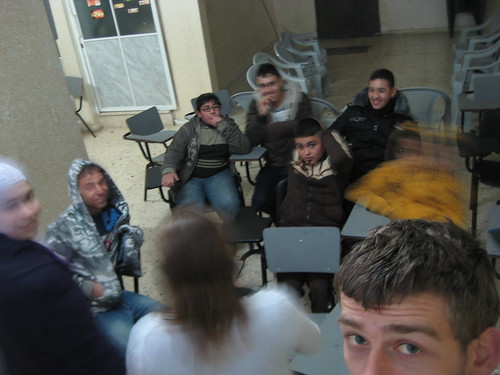
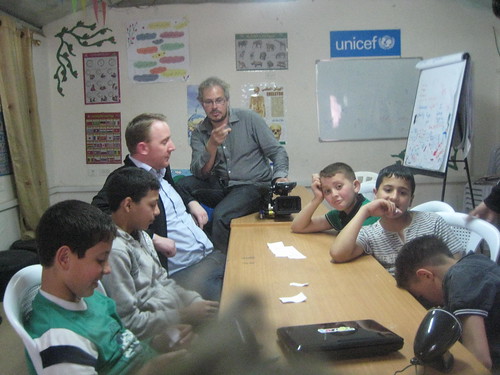
Things kept changing, changing, changing. My class in Askar started as an English class, an hour long. I shadowed the volunteer before me and witnessed the group of refugee kids devolve into a literally screaming mass before my eyes. The classroom setting was similar to this one:
IMG_2465

The next month was spent building trust with them, getting them on board with the idea that if they wanted to learn something fun and creative they'd have to work together to keep the class focused and the disruptive kids in check. We worked on art, photography, and English, and they never screamed or jumped on the desks with me like that first day. Sometimes 13 kids would come, sometimes 4. Then, after a very successful field trip, just as we were starting into film, things fell apart. It took them 45 minutes to do something my other film group had down in 15. I didn't trust them with the cameras, so we took them away. Selma, my co-teacher, said they didn't seem to be getting anything out of the film classes, and we might as well switch to English, and I agreed. When I told the kids that our attempts to do something fun and different had failed, and we would learn English from now on, they didn't flinch for a second. A boisterous, obnoxious girl who suddenly appeared a few times ago simply said she wanted to do English anyway. I told her that I knew she wouldn't behave or pay attention, I'd seen her previous behavior, she shrugged and said she'd be better next time, which is what she always said. The next time we went there were only 2 students there, and we decided to call it off.

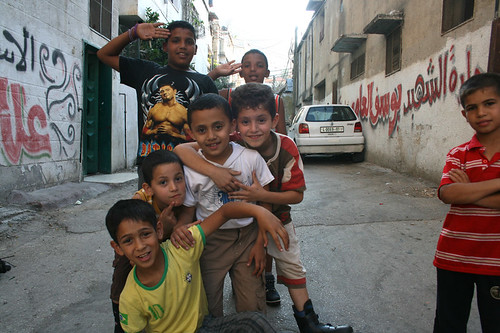
In the meantime I was teaching English classes at every level of competence and working on independent film tutoring and projects. I was losing faith in the idea that cameras could be used for anything more than visual aids in learning other subjects, but at the same time I'd hear or learn about other projects that sounded wildly professional and successful, Cinema Jenin or Tomorrow's Youth Organization. It was frustrating. Then I had the opportunity to teach a 6 class film course at the Happy Childhood Center in Balata. It wasn't ideal, as cramming as much material as possible into a 2 week course wouldn't give the students the autonomy and self-empowerment needed to keep their projects up after I left. But it was better than nothing, so I went into it full force. It turned out great. Of the group of 10-12 kids 3 boys and one girl were really keen on the film projects, and two of the boys have wanted to continue working together. We filmed around the camp in a number of fun exercises and made a few good first videos. Monsour and Nayef were the most motivated, they made the contact and scheduled this interview about a house that was demolished by Israeli soldiers:


Then they made this little piece on the day a prisoner was released and talked to him:


The girls took pictures and made a sildeshow of the difficulties children face in the camp, especially girls. We talked a lot about the challenges they had even finding girls to film because all of the spaces in the street are for boys:


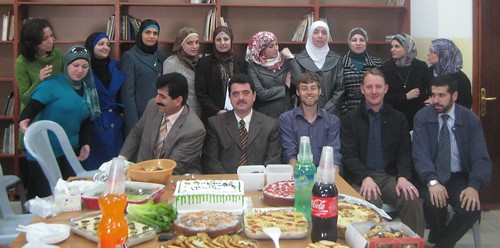
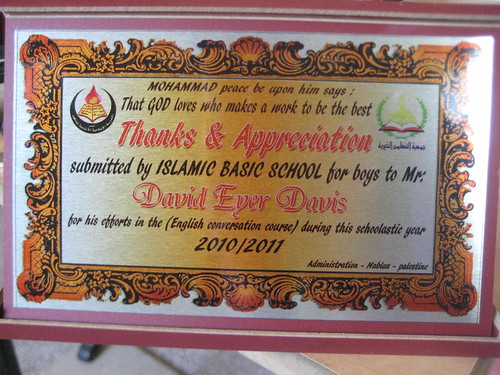
The more involved I was in film, the less I sweated the details in the English classes, but they turned out pretty well as well, as I was getting more comfortable with my students, the material, and teaching in general. I tried to keep things focused on discussion and grammar, as the students here are generally quite advanced in terms of vocabulary but never speak or speak timidly, so we did a lot of confidence building stuff. Those classes got to the point that I was well liked and respected by my students and they even threw me a big party with the director of education and an amazing plaque at the Islamic school, which was more than a little absurd.
IMG_0766

IMG_0768

IMG_0828

Toward the end of things I felt a really good balance between my film interest and my ability to be useful as an English first language speaker. There are some things that shouldn't be taught through translation, like editing, blogging, and computer skills. But at other times kids took the film stuff and ran with it, last week concluded another Balata 3 week course that went great in every respect, the kids doing photo scavenger hunts, writing scripts, and producing scenes even though we only had a short time together.
IMG_0812

They got to see how to take their videos and put them on youtube and after I added them as my friend on facebook they got excited about the idea of showing me their future creations. Here's their first little scene, about neighbors who are so cramped they start to argue when one accidentally throws trash out his window at the others:


On the documentary front we made a little scene illustrating the inadequate spaces kids have to play. They got one of their friends who is a good as soccer to play in a narrow alley, and the narration talks about the challenges they face in the refugee camp. Then we decided to fool around and film some soccer commentary, which turned out pretty great:


Now that I'm done, part of me feels totally comfortable with this, with the fluctuating attendance, missed translations, and faulty equipment. Towards the end if I showed up to a class and my co-teacher couldn't come I'd just plow on through in crappy Arabic and teach the courses by myself, and they'd turn out great. But when I think about what I want to do next here, and people say, 'oh there's a job opportunity teaching English in X organization', I say, "Hell no!" Looking back on these three months I realize what an invaluable opportunity it's been to volunteer with Project Hope. It gave me a perspective into the way Palestine really works culturally, politically, and logistically, and did so in a way that is locally empowering and locally led, which is really important to consider if your contribution is to be useful.
Read More......
Monday, April 4, 2011

Death of an Artist: Juliano Mer- Khamis


Playwright, Filmmaker, Peace Activist, and Community Builder Assassinated outside his Theater today in Jenin.

This is awful. I met this man when I went to his play, Alice, at the Freedom Theater. He was kind to strangers, offered me food and spoke at length with me even though it was a busy day for him and he had never seen me before. He calmed a theater full of 500 children easily and spoke gregariously to them, making sure they knew the performance was for them and that they could be heroes if they tried.

He was a mover in his community and worked to give people some color in Jenin Refugee Camp. He does the same work the people and compatriots I respect most do in many other countries in the world, and he was shot dead for it. He had a beautiful baby boy and another child on the way. Rest in Peace.

To the venomous, to the angry, to the oppressed: If you're going to harm someone, spare the artists. Aim for the greedy that oppress you, not those trying to bring life, toiling in your midst.


I recently discovered this video featuring an interview with Juliano, sadly it's exactly the kind of film I came to Palestine to help encourage: It highlights an exciting program and the people behind it, while showing us a little about the lives of the people here, their hopes, aspirations, and humanity.

Read More......
Saturday, April 2, 2011

Asra Karim- Teaching in Nablus


Finished my second little film featuring the people and places in Nablus. This exceptional woman is the most on-it and together volunteer teacher I've had the pleasure to meet. While the rest of us shuffle and fib our way through English lessons Asra breezed through like a pro, preparing interactive, educational material for her classes, primary through adult. Asra spent a lot of her time teaching teachers, I personally think she should be a parliamentary member or something. She's a kind, patient, beautiful Muslim lady who speaks 4-5 languages and is at home here or in the west... I kinda hope she's running the world soon.

After her interview I shadowed Asra to her class in the village of El Jneed. The kids were adorable and the location pretty cool, the village is up on top of an incredibly steep hill overlooking Nablus valley. The classes are taught in an old mosque, which was turned into a library when a newer one was built nearby.

My time here in Nablus is drawing to a close, and unfortunately I only have time for one or two more film updates. I think next time I volunteer I want to make these my full-time occupation, they're fun to do and give you a smattering of exposures about how the organization works. Read More......
Wednesday, March 2, 2011

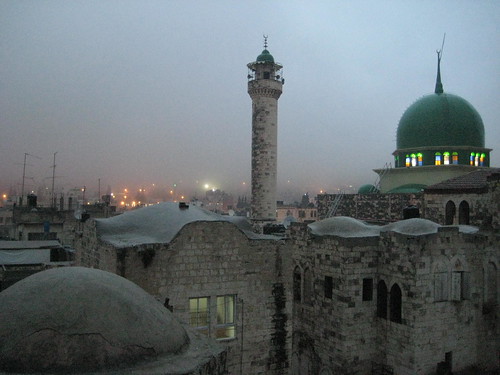
Being in Nablus: Mountain of Fire

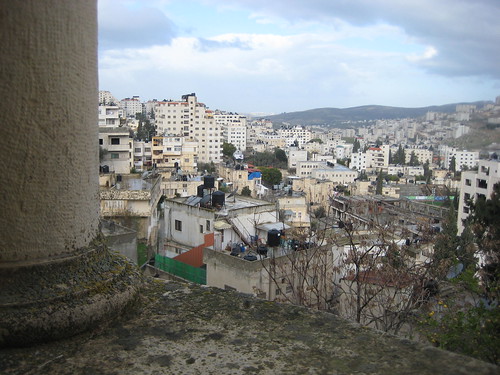
Report to the world abroad: I've been incredibly remiss. I have no idea how to fill in the blanks between a month ago and now. I fluctuate like an aperture, a sine wave. I've had the greatest, the worst, the busiest, and the most tedious experiences of my life all in sequence. Time seems to race by, or it seems a lifetime since I rolled into the West Bank on January 31st. I've been incredibly busy here. Two days ago I thought I was a failure. This week I feel competent, on a good path, useful. Before all that I felt elated, and before that lost. But it's fine. Sometimes it's good enough to move forward, ceaselessly, and let the days shape how your muscles and callouses grow. It's time to describe Nablus.
IMG_2486


To get us started I'll re-wind my notebook to my first impressions, on January 31st.
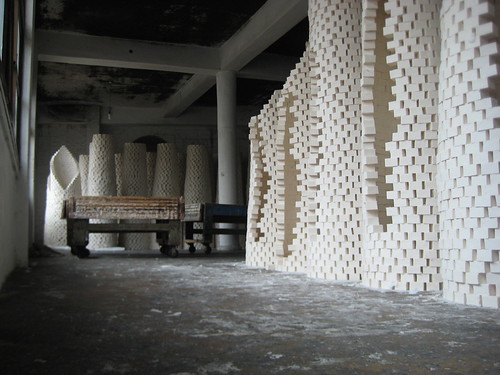
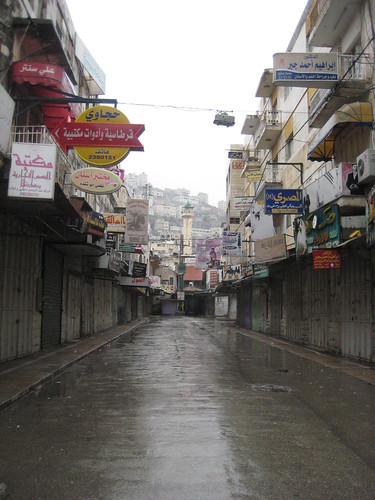
"Nablus is fantastic. I knew before that it was couched in a valley, and that Israeli barriers had destroyed its economy until the militarization ceased in 2009. The city center features a masterpiece of a shopping drag that rises to the south, it's absolutely filled with pedestrians day and night, criss-crossing the domain of merciless taxis. Fashionable stores rub elbows with sooty, wobbly eggplant carts, and boys looking fresh from the club greet wrinkled old men wearing what appears to be conglomerated dirt. There's an incredible food selection in the markets, fresh fruit and veggies overflowing at every corner. Everyone must know how to cook. The main fruit and vegetable market is off the central square in a canopied corridor, typical bustle of people and cheap, delicious stuff. Nizar, a Project Hope employee showed me a few preserved treasures like a large scale functional soap factory, which appears to make one product only: 6 oz blocks of fragrant olive-oil soap, spread out on the floor and arranged into insectoid columns to store and cure in a beautiful old warehouse, the floor slick with the sheen.
IMG_2447

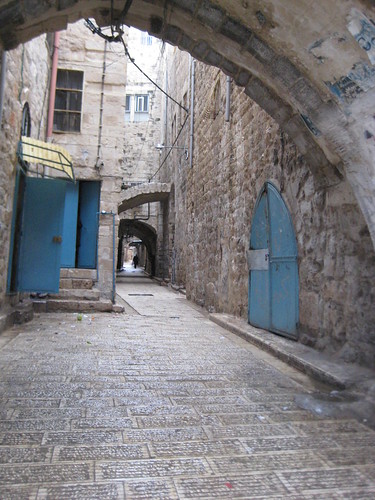
The old city is a remarkable mix of living history and a profound record of the abuse this place has been through. Computer shops operating out of ancient arched-stone structures, smooth walls getting narrower and narrower. It's ancient, and picturesque, but suddenly here and there you'll discover bullet-riddled walls and officially-ensconced memorials to suicide martyrs, from as recently as the second intifada (2002). Nizar briefly said hi to a young good-natured guy who had a vague look about him, who flinched when Nizar playfully pinched his stomach. 'Is he blind?' I asked. 'Yeah, he was injured' 'During the intifada?' 'He was trying to pull apart an undetonated shell stuck in a wall. He wanted to throw the explosive from it, and sell the copper. It exploded in his face.'

The markets here are less crowded but more claustrophobic, filled with delicious sweets, spreads, olives, dates, cheese, and tons of amazing-smelling bread. I'm in heaven. And unlike in Israel I know the rudiments of how to ask for things. But only the rudiments. Palestinian Arabic is tough and my brain is like a lead balloon. I don't hear subtle distinctions and remember things even more infrequently. I think the learning curve's steep but even on day one can see a light at the end of the tunnel. In truth I'm exhilarated to be here. If I hack this one out I may have a pretty rad future. If I could speak Arabic well, I could see myself working in this region for a really long time. Nablus is fully alive, in a way that only a place strangled by a brutal fate really can be."
IMG_2453

I feel pretty good about my initial description still, tempered by a few new realizations that I've come to over time. For one, winter in the mid-east mountains is a perpetual wet spring, with weeks clammy and misty and others in full sunny contrast, perfectly temperate, and possibly even more beautiful. It's a lot like San Francisco, in a way. I think I really fell for this kind of weather in my second week. It had been raining 4 days straight and the world was wrapped in one of those surreal mists that wets your face and helps sound travel. I was walking down a huge ancient set of steps that descend the mountianside beside our house. All chipped up and knobby. It was dusk, and through the fog the call-to prayer reverberated, creating unearthly echoes the likes of which I've never heard. otherwise it was deadly silent. I was alone, in the heart of far away. I live for moments like that. I was so struck by the evening call to prayer I made a little video featuring it later, in the rain. It fails to capture what I experienced, but it's a nice little moment:

IMG_3185

Nablus is my home now, though I'm still a stranger in it. I always will be, no matter how good my Arabic gets. The call of "taal, taal ijnebi/come, come stranger!" follows me everywhere, and depending on the combination of my apparel, company, or mode of transport I'm conspicuous enough to singlehandedly draw substantial crowds. Because of this my relationship to my home is a strange one. The public sphere isn't a place I can be by myself, but I don't mind that. I take pleasure in making friends every few meters and try not to be inconvenienced by it. This level of conspicuousness effects me greatly and changes the way I behave. I rarely take pictures in public, any more, and my photos reflect that. I feel awkward and invasive all the time, pulling out a camera puts it over the top. Of course my photography suffers from this, we'll see if I improve in time and can start asking people for their photos again. Friday is a respite, as the streets are dead, and a bustling merchant district becomes abandoned.
IMG_3173

Since I'm our narrator here what could a visit be without the view-from-a-bike report? It's fantastic. I swerve and weave like a self-possessed fakenger listening to 'a band of horses' and people LOVE IT. Everyone treats you like it's your birthday. I always have an audience here, but on the bike I'm in my element, obviously, and I ham it up, obviously. It's a party. This city's on a hill, so you bomb through the potholes and minarets and dodge taxis, and they roll down their windows and say funny stuff to you then you dodge some ladies jaywalking and cut to another lane of traffic to avoid the lettuce cart guy splitting lanes against you then you swerve around a military gooseneck, pass some autoshops and a landfill, and you're at the refugee camp, exhausted, having about 200 near misses along the way.

There's much more to say, and much more to show, but enough. Stay tuned next time for either the people, the navigation, or even more harrowing, the classes!

IMG_0191

IMG_2530

Read More......
Monday, January 24, 2011

Alleyway deeds and got a steed


Good Morning!

Today was spent doing camera errands and looking for a bike, both of which are scads more fun in a foreign country. Drumming up the courage to interrupt some grumpy old mechanic so you can barter over the merits of interchangable chainrings is something I excel at. Also having an excuse to duck into extremely sketchy dead ends and alleyways is always fun.

So far the candidates are: a too small KHS MTB with rack mounts, front fork, and knobby tires for $100, a too small cannondale MTB (!)missing its front shifter and with some crappy components for $100, or a perfect-sized Mid-80's MTB with XT components for... drumroll, $60. The only problem is its seat post is stuck at bottom height. Finding this bike was my favorite, as it resulted from talking to the locals and finding out about a 'very cheap bike shop behind a gas station.' I round said corner after half an hour of walking and see man in a kefffeyh (shorthand for Palestinian solidarity, perhaps with a specific Fatah connotation) and a veiled old woman sitting with a grizzled group of Arabs in a derelict courtyard. The bike shop is like all Israeli (and Egyptian) bike shops, a single indescribably dingy garage bay filled with bikes on hooks which spill out into the pavement (or in this case, dirt) broken Arabic and no-handed trackstands ensue, both of which startled the folks, it was clear. As did my declaration that I was biking to Nablus. Without fail everywhere I go people find the distances in their lives absolutely unimaginable without motorized transport. When I said I was planning on biking there in 5 days (a very arbitrary estimate) there were literally ripples of incredulity. After a stint of google maps I discovered my admirable feat was going to be all of 35 miles. Come on, guys.

I managed to work out a deal: If the bike seller could un-stick the seat post before tomorrow I'd come back and pick up the bike.

The awed/worried reaction could also be attributed to the obvious socio-political conflict we're all so aware of, but I doubt it. Like any area of strife daily life very much continues at a normal pace, Tel Aviv feels safer than most places I've been. For those of us in the lucky position of mutability there is little danger in the West Bank as well. For average Israelis, however, it might as well be Mars. I haven't had too many conversations about it yet, but having an Israeli passport bars one from entering the west bank, an absurd concept in an area with the footprint of the Bay Area. Though like the locals of that cosmopolitan comparison, the people here seem to try to make up with culture what they lack in national real estate. Israel is a very cool place, so briefly into it I can already see why someone with a different take from mine on the politics of the situation would never want to leave.

Next my hunt took me to the markets of Jaffa, where purveyors of sundry linens and knicknacks rub shoulders with shops selling, inexplicably, tons of beautifully crafted antique film-light rigs with wooden poles and pounded brass carapaces. Coming out of a shop that had, side-by side, a shoddily-mother-of-pearl-inlaid mandolin ($100) and an African chamber-less instrument with 2 strings and demon-headed resonating base ($45) I was approached by a smiling young man with glasses.

"Excuse me!" He said, can I ask you something?"
"Sure" I think at this point he's trying to drag me into his shop. "But not about linens. About bicycles!"
He laughs. "I'm an artist. A photographer. You have a look of someone I'd like to photograph. Can I tell you more about it."
So now I'm over thinking he's trying to sell me something, and into thinking he's trying to pick me up. I humor him for a few moments before his friends wander over, a cute red-bearded fellow with a rather excellent flat-bar road bike and a good-looking pixie-ish girl with baggy pants. It turns out:
1) The fellow, Daniel, is actually telling the truth and doesn't want to pick me up. We're shootin' some photos Tuesday.
2) His friend Yoav is on couchsurfing, lives in a loft and wants to host me tomorrow.
3) His friend Tal invited me to go volunteer with refugee kids for the evening at an outdoor library. So I did.

She's a great person, Tal, we immediately had some good conversations about performance art, queer identity, and our relationship as individuals to our nations. Dere she is:

She told me the scoop on this park (Ha Tinkva?) we were headed to. Apparently Eritrian and Sudanese refugees flood into Israel all the time, seeking to become nationally recognized refugees but in reality being held in limbo as 'asylum seekers' that supposedly cannot work and are initially detained for several months before getting shipped to Tel Aviv. This is another moment of odd parallel stories for Israel, where any Jew in the world can expatriate to the country but in the treatment of other asylum-seekers it becomes obvious that the state being sought is still very much a Jewish one. But apparently the very park where we stood was a focal point to this whole international conundrum, as the majority of the new asylum-seekers end up at the central bus station a block away and sleep homeless here until they find apartments and illegal work. Indeed, over the course of volunteering there one night several timid class-style packs of Israelis crept into the park and observed and discussed the goings-on ethnographically, apparently the general vibe the place holds in the Israeli concept is that of the ghetto: dangerous, scary, you just don't go there.

Happily oblivious to this fact, I was busing myself helping to run a open-air library.

It was patronized by hyperactive polyglot round-headed children, who would jabber at me in English, Arabic, and Hebrew. There were books in all three of those languages, and we generally had a blast trying to keep them entertained. They didn't seem to naturally have the reverence for books that I somehow picked up living in a bookstore with a literature-crazy mother, I cringed as battered, ancient, spanish translations of 'Le Petit Prince' went flying around the park, spines ripping apart. After considerable despair at the mayhem (which included a game where three or so 6 year olds would climb to the top of the book stacks, yell at me, and then leap-attack my head when I gave them attention) I resorted to juggling, climbing, and finally leading a rag-tag gang of kids to the jungle gym nearby to do some proper horsing around. We had to displace a couple deflated loafing types that were huddling conspiratorially in the playground, the contrast of these little kids horsing around and infringing on the claimed space of drug-dealer-esque setups was pretty surreal, especially when you'd look up and think, "I hope someone's looking after these guys" and you realize it's pretty much just the lurkers and you taking up that job. This guy pretty much sums up the energy level for the night:

After dark, thoroughly tired out, I walked back to the hostel and made an olive-filled bachelor stew before chatting and writing the night away. Day 2 down, dig it.

Day 3 turned bike theory into a reality. After Arab guys weren't able to un-stick the seatpost (with a hammer, chisel, and a pipe-wrench, no less) I abandoned option A and went back to the first bike I found. After tinkering on it for a whole day I landed it for $125, which is steep for me but whatever. Witness! The ITS (Israeli Turn Sandwich) Refusnik:
That's right. True Temper, suckas. Yeah!

Many readers will soon quake in fear as together we conquer spans that only sound impressive in meters. Stay tuned! Piecing together ol' Refusnik was made especially fun by the to-and-fro scavenging I'd go on to abandoned bikes in the area when it was in need of a part, much to the entertainment of the shop owner, Elian. He's a downhill biker and his shop was different than most, by the end of the day he offered me a job! :) If only I was learning Hebrew...

Later I went to a nightclub on my new steed with the owner of the hostel. The experience was complete with an unmarked door, descent 2 stories, a security pat-down, and an ex-soviet-style bouncer whose neck was wider than my whole body, a pit-bull of a man with bulging veins on his forehead and a shaved head. He looked like he bashed his face through brick walls for breakfast. Other than that the club was boring as hell.

Here are assorted piccies from the day:


Cutting out comics to give to kids as gifts.

Thu-thu-thats all for now, see ya.
Read More......
Saturday, January 22, 2011

Made it! Now we really start up...


I was nervous off the plane, expecting an interrogation. In that vein I had locked down my phone, erased all my emails, replacing all my incriminating files on my computer with vague titles, hid my extra SD cards, combined my tripods to make them look like there were fewer of them, and moved my bookmark to the beginning of my slightly incriminating book. And of course I prepared a goose-chase of stories justifying my need for a 3 month visa without getting an Israeli stamp in my passport. I had even kept my notebook reflections vague, in order to match with my innocuous front.


So imagine my disappointment and surprise when subverting the vaunted Israeli airport security consisted of babbling to two (very cute!) women about my love of bicycles and fresh dates. No search, no hard questions, just skepticism at my ability to pedal 200 miles. I still have to get through the West Bank checkpoints, but I probably could have gotten away with bringing all 5 cameras. They're apparently harder on you on your way out.

There are no trains on Saturday, so I accosted strangers to share a taxi into city center. Got a ride with Claudio, an Italian robotics professor who works in Artificial Intelligence. His destination was a nice residential neighborhood, lots of people ambling around, cute young couples mostly. He paid the fare (business expense!), and told me to take Sderot Rothschild vaguely toward my hostel's neighborhood. I had no maps, just street-to-street directions I'd scribbled from the web the night before, so I was worried. But the street was pleasant, a walking boulevard filled with perambulating people, bikes zigging around.


The whole world working at about 1/3 capacity on the Sabbath. Tel Aviv is a flat, fairly ugly city with a a lot of little shops and good vibes, cool and breezy but t-shirt weather in January. It reminds me of Athens, dirty and un-neutered cats all around, scooters and motorcycles, beautiful people. I just walked over an hour and eventually found my cross street.

The sketchiest street encountered so far is the one the hostel's on. It's in a little pocket of wasteland! That's it there:


But upstairs is a proper hostel scene, free Internet and tea, hammocks on the rooftop, a sweet pink-haired Argentinian to check us in, dates and lovely dirty kitchens and lots of conversation.

Hit the ground running talking with Matt, working with Anarchists against the wall, a solidarity movement that goes around protesting wherever locals are protesting in the west bank. Here's footage of similar stuff from 2 weeks ago in the town he's been going to. Says there's lots of tear gas fired directly at protesters, use of live rounds, and that the stone-throwing is usually in response to IDF aggression. I don't know how I feel about it. It seems presumptuous to go somewhere far away to engage in protests of other people's struggles, I don't feel personally well-informed enough half the time for protests in my own country. They also seem pretty ineffective and formulaic. But perhaps the internationals have done their research and this is the best way to further their goals. And surely effectiveness is a lot to ask for your average Palestinian.

In any case, he's a cool guy and had some good information. He also holds the dubious distinction of having his bone structure carefully delineated in a tattoo on top of his left hand by someone while at the hostel. He's also responsible for this turn sandwich:

Oh bike co-op travelers, how you represent.

He told me about Ragotka, a vegan coop that has all sorts of interesting radical connections, I'll go check it out tomorrow.

Also talked with Ginendy, a New Yorker who came over with a moderate pro-Israel group that trains college ambassadors for the country. And Bram, a Dutch journalist here to do stories on Dutch Holocaust survivors and their generational relationship to the trauma. Bram and my current (very informative) book, The Lemon Tree, remark on how Holocaust survivors are seen in an oddly unfavorable light considering their weight in their country's history. They have been construed as weak and cowardly, carrying the burden of brutalization by the Nazis, as if they only half-survived, a people of dust. They suffer especially in comparison to the myth/stereotype of the sabra (prickly pear) or the stubborn, macho new generation of Israel which was able to cultivate a modern empire out of the fertile void of the desert and fight against persecution ruthlessly and more effectively than their forebears.

Skepticism at the stereotype aside, the origin story of Israel really is amazing. Disdain for capitalism falls away in the face of what early Israelis did with the benefit of that system. Immigrants from Europe arrived in the thousands in 1948 and in a few short months they created a skill-based import/export economy from the ruins of the previous Arab society. They ran everyone out as war refugees and declared the new Jewish settlers custodians of abandoned property.

As such they had the basic infrastructure and resources of existing Palestine to work from, but still the prospect of turning an ancient, empty land into a 21st century cosmopolitan civilization in the space of 60 years is audaciously mind-boggling. A good reason to dislike capitalism in general is that it does not put the welfare of people as a first priority, it becomes an end in and of itself (more power) rather than a means (providing stability to people so they can follow their priorities, like living their lives). The more correct role of capitalism gets made very clear when you're dropped off in a blank land and made to fend for yourself, and in 7 months there are municipal offices and enterprising businesses. But when comparing early Israel to the parallel struggle of the Palestinians you start to see the huge advantages created by having stable international connections and a multitude of socialized programs in place to kick things off on the right foot. Israeli immigrants were given a house, a lantern, a bed, and rations for flour, sugar, oil, eggs, and milk. They, like the Palestinian refugees, were largely dependent of foreign aid shipped in at first, but unlike the Palestinians they desired to build upon their situation and dug in, whereas the Palestinians wanted to return to their homes. Palestinian refugees were dependent on UNRWA aid in 1948, and many still are.The Batala camp in Nablus is the largest one currently in existence. In the meantime Jews have created places like Tel Aviv.

I have to continue this train of thought a bit further, annoyingly enough, for it's beginning to sound like I believe Israel sprung from ruin into a completely autonomous moneyed super-state thanks to a champion cottage industry. It's not quite that simple. Because apparently soon after this industrious time of can-do-working-the-earth mentality Israel started down the same road of imported labor and exploitation those of us in more developed countries know so well. They took the let's-use-the-less-auspiciously-colored-in-the-skin-department people from around the region route, mainly Mid-East Jews known as the mizrahi. Further, we can't forget that the US aid to this commercial giant in the defense game alone makes the dependence of the Palestinians on foreign aid seem like a crumb pile: A conservative estimate puts total US military aid at 114 billion.

Aaannd we're back to capitalism fail. That was quick.

Jeeze. I started with a cool bohemian hostel and got here, huh? I guess that's telling. A clue of things to come, perhaps. The rest of the night was just fine, dinner in an actual expensive restaurant (Honest!) with wine, ambling through graffiti-ed streets surrounded by what seemed to be squads of dark-haired transplants from east cost finishing schools headed to food and parties.


Now the snoring of hostellers. Just fine. It's good to be here, my brain's workin, we'll see what we see.

Read More......
Bye