Showing posts with label Middle East. Show all posts

Sunday, March 13, 2011

In the hands of strangers: Palestinian Hospitality

IMG_0082
Some strange things have happened this week here that illustrate how different things are when seen as a whole or in the extreme. I'll write about them in due course. For now it's time to spill the beans on how easy it's been to be in this place, largely regarded as a tragic, intractable war zone. Right on the back of a most excellent weekend filled with good conversations, delicious food, meeting interesting people, and comfortable progression in the Arabic department. As anyone who's traveled in this area of the world knows, Middle Eastern hospitality has no bounds. For those who don't know, imagine that everyone you meet is a slightly autistic stalker, and then take away any connotations of fear, danger, or prurient interest. This description is immediately problematic, as it paints Palestinians in the unfavorable light of not knowing social bounds, or being so gormless as to latch onto any passerby. But as far as I can understand, society here is just that much more open. People know almost everyone they interact with on a daily basis in the markets, the streets, the neighborhoods, if you're a new face you stand out. The novelty of being a foreigner certainly heightens this, sometimes to a kind of celebrity status, but deep behind the cries of "Welcome to Nablus!" is a culture of respect that exists between people here. Simply put, almost anyone will go out of their way to welcome you and be your friend.

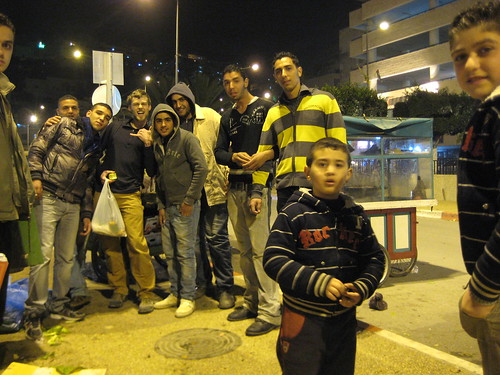
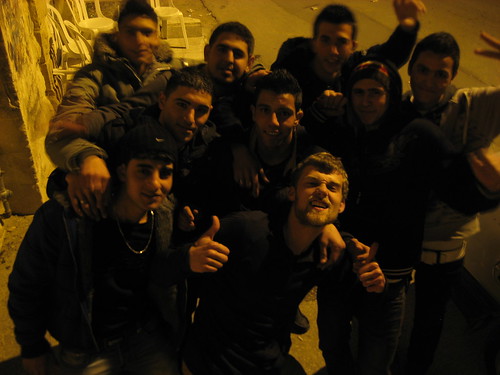
Now, a month in, I have a kind of routine, who I buy things from, who I stop by for a quick chat with, who my good friends are (though that last one's a toughie, as the organization I volunteer with keeps me improbably busy and I literally RUN from class to class, preparing and shooting video on my off days, more on that soon). I have my strawberry guys, who are young and insult each other. My half-yelled childlike introduction with them drew quite a crowd:
IMG_0095

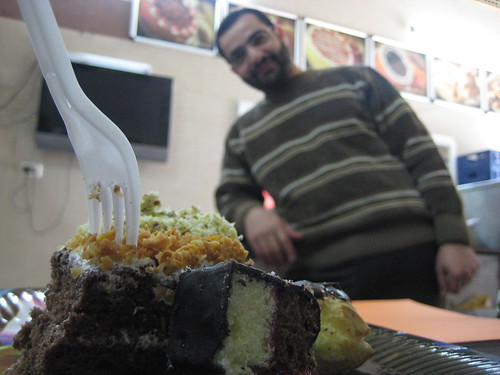
When I have time after walking home from class in the Islamic school I do a bit of language exchange with Arafi, who happens to have the excellent occupation of cake seller, which means sugar high at 10:30 am.
IMG_0194
I literally think I have ruined my teeth forever here. Despite biking, running up stairs, and Thai Boxing, I've gained 5 pounds for the first time in my life. But we were talking about non-edible encounters.

Language is such an interesting factor in determining relationships. Depending on the fluency of the speaker concepts can either be basic or complex, and my personality fluctuates to suit. So with the vegetable sellers who speak no English I am always a comic, gregarious figure, who blunders through Arabic and mostly talks about where he's going and where he's been. With my co-teachers at project hope I approximate myself, but as a caricature, an ambassador of America which they attempt to match up with their notions about that place. It is only with a few people here that I feel I am myself, and unfortunately that's mostly a handful of the other international volunteers, who have a firmer concept, for the most part, of the variety of ways we have to be in the west. For whatever reason, to my fresh eyes, places like Palestine don't encourage strong cliques or subculture in the same way, say, San Francisco does. There are certainly artistic communities, and writers, and musicians, and other vocational preferences or lifestyle choices, but there seems to be a much stronger mainstream that bonds over similar cultural values here than in "the west."
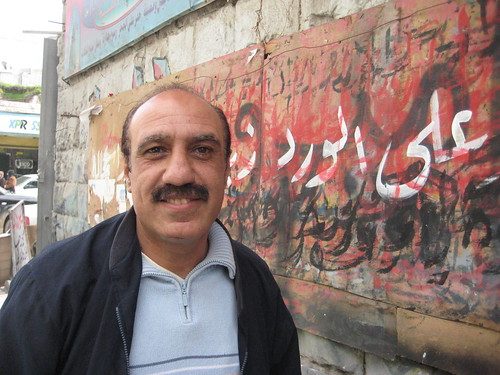
IMG_3226
Husam Abu Heyat (Husam, Father of Snakes!) Artist, Calligrapher, Graphic Designer, and Painter, Jenin.

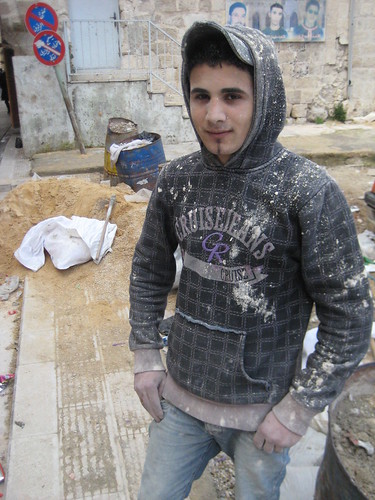
But no matter who I talk to, in either a simplistic conversation in the market or a full-on discussion with my near-fluent student's family over dinner, there is a deep willingness to be understood and to share Arab culture, to share Islam. Friends and I have long conversations dissecting perceived and actual value differences between our cultures, people give me religious texts and even a English-Arabic Quaran, which I treasure and wonder how I'll be able to take it home. People use our broken language connection to grill me on what I know about the faith, and small children, after finding out I'm not Muslim, inform me in Arabic that Islam is the best. Why? Because it's the best, duh! The other day in Ramallah I sat down by a small tin-fire with some taxi drivers and one of them walked up, made a joke at me, which I responded to, then he said "Yalla let's go prey." It was Friday, the holy day, so everyone would be at the mosque. I said "sure" and he led me through the fruit markets of a city I'd never been to before, quickly cramming inside the mosque and lining up in perfect unison with 750 other men. They would grunt in assent with the Imam as he led them through their prayers, creating this breathy, huge vibration through the room, like a titan clearing his throat. Super cool. Moments later a casual stop in a bakery led to a half-hour long excellent tour spanning two buildings and rickety spiral stairs, seeing all the whirring, anachronistic machines and too-fast workers. The working class are often very young or very old here, I seem drawn to the construction and carpentry workers in the old city, who are usually chalky with plaster or sawdust. IMG_0226
There is a flip-side to all this generosity, however, which is of course the inevitable stress and claustrophobia that comes with too many social obligations. Everyone is grabbing at their phones every five minutes, and it seems perfectly acceptable for a co-teacher to stop translating the lesson mid-sentence and take a call. This coincides nicely with the fact that most phones appear have no ring-silence button and will continue to ring incessantly until the call is rejected or picked up. Indeed as I write this I have ignored 10 calls in the last 3 hours, half from unknown numbers, and half from a group of boys that have a habit of hanging out outside the door of our place here, heckling the other volunteers and yelling my name until I come shoot the breeze with them.
IMG_0222

They speak freely with me but it usually takes quite some time until I'm not an awkward center of attention, holding up the conversation with translations and exchanging predictable platitudes about both cultures. That's probably the most tedious part of being a rudimentary speaker and an icon of westernism: the predictability of the course of conversation. Kids of a certain age ask you whether you support football teams FCB or Real Madrid (those two only strangely, like, jeeze Palestine, what's the big obsession with Spain?), or which WWE wrestler you like. They ask you if you know the wrestlers in real life, while in the back of my mind I'm thinking "wait, these programs still exist?" Older boys talk about either sex ("is it true you can sleep with whomever you want? how many girls have you slept with? Which are better, European or American girls?") or about the problems of Palestine. The sex question's getting pretty interesting, I'm just getting to the point where I can stumble through a fight for gender equality and point out that women are pretty involved in the whole consent process and generally are interesting people beyond their reproductive characteristics. Note as well the dearth of women in these pictures, largely because my life is in the public realm, where there are less interactions with women, and most women despise and detest being on camera. All my professional relationships with women are great, however, and probably deserve their own (upcoming!) blog post.

Adults talk about politics and Islam. Along these lines, everyone tries really hard to dispel the notions of Arabs as fundamentalist terrorists. But they needn't bother. It's clear, as a collective culture, that Palestinians just want to live freely and not be impoverished and humiliated. Their hearts are filled with love, empathy, and respect. I feel so much more gentleness and desire for peace here than I do in Israel. More than I do anywhere, for that matter. In respect to the occupation most people show an astonishing, life-long patience that floors me. The fact that this place isn't a gun-filled riotous shit-show all the time speaks legions to the Palestinian desire for peace. Everyone's stressed. Everyone knows someone who has died, who's house has been destroyed, who's in prison. Everyone's stretched thin financially, over-achieving but for what purpose? They're all motivated and intelligent, and daily life here is very close and satisfying, but there's the root listlessness, because they can't leave very easily, so there's an absurdity to excelling at anything. What's the point of being the best thai boxer or painter or mathematician if you can't get a job in it and there's little chance to leave Palestine to conferences or to start a business or whatever? And there's a breaking point. My friend Mamoon lives in Balata, one of the largest refugee camps. He's a thin-faced fellow with kind eyes, good natured and a good translator, waiting until he understands the beginning and end of an idea before accurately conveying the mood of it. His father died 10 years ago and Mamoon and his brothers support the family. He awakes at 6 to study English at the University until 2, when he volunteers for Project Hope for an hour or two. Then he grabs a bite to eat and works in a printing factory until 2 am, at which point he does it all over again, 6 days a week. And still he walks slow. And still he waits patiently for people to ask him favors. And still he commiserates with a silly foreigner who complains about his heavy workload of a handful of classes a day.

People shoulder the burdens of stress, lack of opportunity, inequality, violence, corruption and poverty with a grace and magnanimity that makes these things almost forgettable, and it's the power there that speaks to my heart amidst the sea of voices in this aged, blind, clumsy struggle. Forget what you heard. Palestine is a land of the best examples of human beings.
Read More......

Monday, February 21, 2011

Meet Salah: The first foray into the people of Nablus

I met Salah early in my time here in Nablus, and he immediately struck me as not only photogenic but a generally gregarious and well-spoken fellow. I quickly got along well with him and started to learn some pretty interesting facets of his personality. He seemed an ideal first ambassador to Nablus. See what you think of him!:


-Salah is a volunteer translator at Project Hope, a computer science student, a Thai Boxing instructor, National Champion of K-1 Kickboxing, a good Muslim, and a Palestinian. He really loves Nablus, and wants you to, too!

Salah's profile is the first of many features to come about Nablus, if you're here and want to hear about someone in particular let us know, or if you're from abroad and want questions about Nablus or Palestine in general addressed in film form drop us a line! Who should we profile next?-

This was a fun project to do and I'm keen to continue it. The intention is to profile a different person or aspect of Nablus every two weeks or so, depending on my schedule. Right now I'm splitting my time between a steady course load of english classes, projects like this, and intensive video workshops. I'd really like to thank Asra for lending me her camera to film with, and Project Hope of course for making my time here possible and allowing me to spend my time on alternative projects. Read More......

Saturday, February 5, 2011

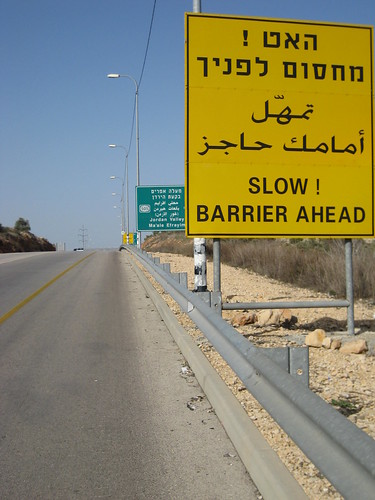
Slow! Barrier Ahead!


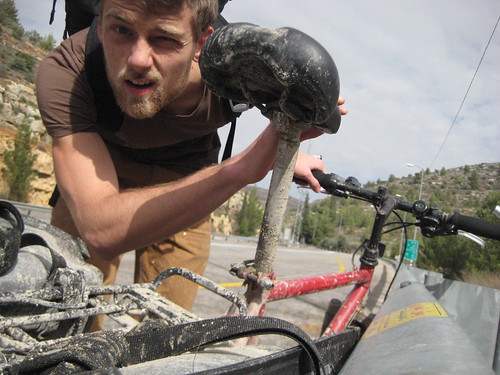
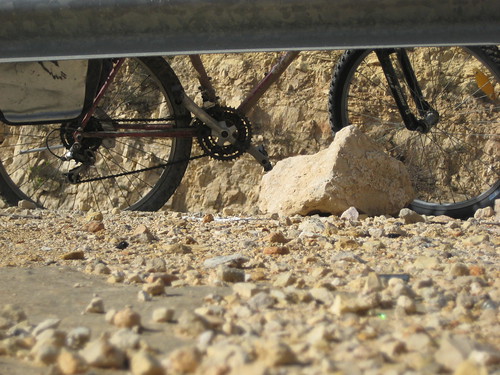
Riding a bike through the west bank is a certain confluence of insanity and privilege that is as hard to justify as it is unlikely to occur. But it did occur, so now I'm going to justify it.

Well, actually I'm not. Screw justification. I'm alive and nobody's blown the world up just yet, so I do what I do and try to actively help other folks in the process. But I do think there's a lot to be learned about militarized zones, identity-controlled existences, and the politics of space within the little soap bubble that is me biking from Jerusalem to Nablus. I will also boldly say that it was one of the more pleasurable little adventures I've been on.
First off: Google maps has deigned not to give names to the city streets within the Palestinan Territories. The interesting thing is that we've grown so used to using technology that this is strange. Next time I come I'll probably be like 'what? no street view? Pah.' Being the seat-of-the-pants type I never thought about bringing a map, I just set off in the direction of Ramallah with a list of cities to head for and major roads connecting them. I'd figure I'd ask people along the way. Now, it's Saturday, the Sabbath, and I'm wandering around the rainy, empty-of-cars-streets of Jerusalem thinking of going up to the nearest culturally-complicated (in appearance) Jewish fellow (his felt hat in a trim little raincoat all of its own) and asking "scuse me, do you know the way to the west bank?" There's one problem for you: how to ask for directions when you don't want to tell someone where you're trying to go. Unintentional freeway riding ensues.

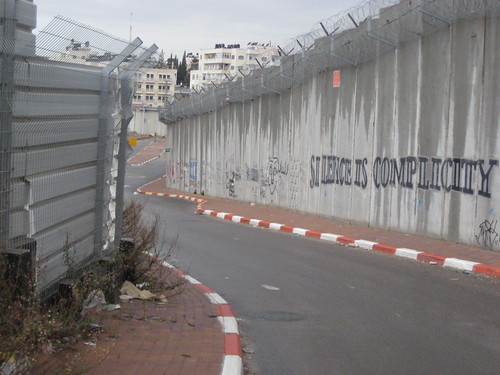
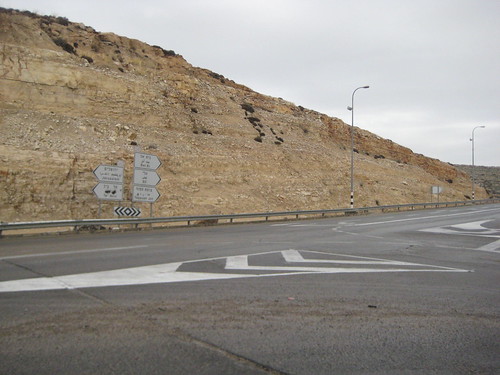
Next, there's the troubling little habit of routes sometimes inexplicably dead-ending into walled-off refugee camps that are apocalyptic in appearance. This is officially the only bike tour I've been on where certain routes seem direct until, looking at a satilite image, you notice the shadow being cast by a 20-foot 5 mile concrete barrier, and you have to figure out which side of it you're supposed to be on to continue.


Now, remember how 15 miles from here there are lush gardens where 20-somethings lounge on a hilly paradise tending vegetables, hiking trails and watching the sunset? This is the same country. The people are just as kind to a passing biker, but now when I ask for directions I speak arabic with a beautiful young woman in bright clothes and a hijab who looks as out of place on a trash-strewn sidewalk with military jeeps and broken concrete as Marilyn Manson would look in a preschool. I didn't take many pictures as I crossed into the west bank, mostly because I was incredibly intimidated, but it was pretty damn end-of-the-worldy.


It's still raining at this point, just FYI.

Now comes the fun part where you pass the checkpoint (which was actionless going in, it's going out where they getcha) and start asking directions to the next town. Sometimes it's quite easy: you wave at a cab in traffic to roll down his window, and in very broken arabic ask whether this road leads to say, Jaba. At the time I didn't realize it, but it's a modern miracle everyone understood me, because pretty much every word in the sentence "Does this road go to jaba?" is different one country over in Egypt, where I last studied Arabic. Other times it's more circuitous, such as when, still raining, I passed the green line into the outskirts of Ramallah and was admiring the trash, cats, and other third world conditions (oh and I was lost) when I was waved over to an auto shop by a gaggle of mechanics. I say hi, exchange pleasantries, and then an exchange almost exactly like this goes down (again in arabic):
"So is this the road I should take to Jaba?"
"Do you want to drink tea with us?"
"Oh, thanks, but no, I have a long way to bike"
"Where are you going?"
"Nablus"
"Oh god, by bike?"
"Yeah, crazy huh? Is this the road I should take?"
"Are you married"
"Uh?"
"Do you want to have sex?"
"Um. Jaba?"

So there's that. It's still raining. A couple good cheers from passerby and attempting to help un-stick a high-centered car later I found my way and started into some rolling hills on what I knew was the right highway. The rain cleared up and I got really, really happy. Everything was thrumming along well, it was beautiful and I had some fruit (but no real breakfast (Sabbath in Israel= closed everything)). I started noticing the following things:


Palestine pretty much looks like southern Utah, the crusty unremarkable bits that we all know so well. Beautiful but subdued.
Settlers scratch out signs in Arabic or cover them with stickers. They also put up lots of wheatpastes in Hebrew.
Middle Eastern drivers rock, I've never felt safer on the side of a small freeway.

Though the day was beautiful and I had plenty of water after a few hours I started running out of steam and thinking of lunch. There I encountered another problem unique to the region: How to best ascertain whether I'm approaching and patronizing a nice downtrodden Palestinian village or a bastion of western manifest destiny and exploitation: A notorious settlement (that, for all I knew, only just that week stole the water rights from the surrounding area)?

Being nervous about betraying my politics I passed a number of lunch spots (as it seems to be the style around here to keep the highway far from the towns with long exits into them) in search of a definitely arab one. I was flagging, but resorted to a pretty fantastic emergency measure: After resting and drinking water I spied a double-long semi pulling out of a by-road. I did a little wave to the driver then sprinted, catching up in a marvelously well-timed maneuver and grabbing onto a sinch-strap on the back of the truck. Thus I skitched a truck along around 8 kilometers of rural highway, weaving in-and out of the rumble strips to the side of the road. I had a car of young men pass me and my host vehicle cheering me on like it was pretty much the coolest thing they'd ever seen, and I admit I felt good about the situation myself. I hung on until my arm gave out and then resumed my overloaded mountain bike progress.

I had lunch at a town called Turmisseyh, where I stopped at a hardware shop and asked about lunch opportunities. There I met a nice guy named Mustafa, who said, "Oh, you're an American? We're all Americans!"
"Uh-huh," I said, appreciating the gesture of acceptance.
"No really" He said, and pulled out an American passport.
"Oh. Wow. You're serious!"
Apparently the village consists of about 8000 people, 6000 of whom live in America. Makes your head spin, coming to a place known to restrict movement more than almost anywhere else on earth right now and make small talk about the details of say, the Chicago rail system.


After yummies a long religious lecture "All the other religions were created by man! Who can believe the word of man? Islam is the word of god!" and the discovery of Kaki (we call 'em persimmons and they're delicious) I headed out again.

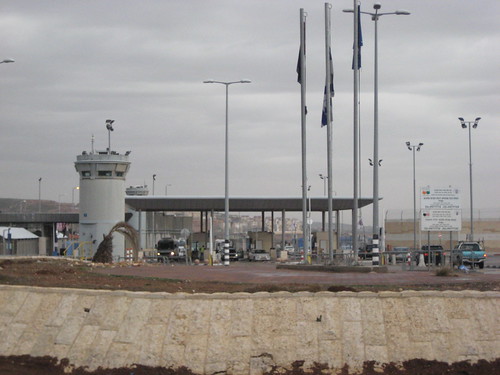
Being back in Arab country, especially roads less traveled, I'm reminded of the fever pitch of hospitality and curiosity about foreigners. In smaller towns every single person wishes to talk to you and befriend you, you'll literally turn down 3 invitations to lunch as you pedal by. As I got closer to Nablus this started to fade slightly, but even still you could make fast friends with ANYONE on the street. Nablus, it turns out, is a big deal. It's said to be the biggest city in Palestine, though I would have thought that distinction belongs to Ramallah. Certainly the first traffic lights I saw since Jerusalem popped up well inside the city itself. But first there's the infamous checkpoint. Because Nablus is a bit of a west-bank problem child. Due to the two biggest refugee camps bordering the city and the ancient heart of the city itself, Nablus but up the strongest fight during the second intifada in 2002. It was here, in Balata camp, that Israel employed the 'through walls' technique which I believe American troops used in Iraq. The camp was so close knit and tight that IDF troops simply went in one house and blew their way through all the rest of them, stunning and killing as they went and never exposing themselves to outside enemy fire. Lovely lovely. Anyway, as a result of this stubbornness Nablus has had a blockade around it since that point, which in 2009 was relaxed into a checkpoint.


But still I rolled up to some rather incredulous IDF kids (no, really, they're kids. I'm talking copious pimples).
"Shalom, Hi!"
"What are you doing here?"
"Um, biking. I biked here from Jerusalem."
"Today!?!"
"Cool huh?"
"Why?"
"No idea. It's just kind of what I do."
"But why here? You know it's very dangerous, right?"
"Oh sure, I'm aware, but I'm willing to take that risk. Ya see, I speak a bit of arabic and I wanted to practice it."

This conversation ended with them informing me that nobody was allowed through on foot. I decided not to enter into the rather interesting philosophical debate about the exact set of parameters that makes a vehicle a vehicle and instead said "oh well, can I go hop in a truck?" They assured me that'd be fine, but after my passport was seen to be "in order" (which is funny, as I don't have an entry stamp to Israel in it) they waved me through. And muddy, tired, happy, and unscathed I made it into Nablus, which exceeded my initial expectations and continues to make me happy and blow my mind. But that's another story.


Read More......

Friday, January 21, 2011

Time to take off.

The time, as they say, is finally upon us. I fly out to Israel this morning.

In the last 3 months this plan has gone from a theory to a reality. Along the way encountered all that I love about my world of friends and acquaintances, and through their cumulative actions I've been emboldened in so many ways.

Through the efforts of my community this project was made not only affordable, but almost completely funded by independent donations, a hugely generous grant from Kids With Cameras, and in-kind donations from Children's Media Workshop and The Salt Lake Art Center.

As I got closer to the departure date I learned more about the project. My main focus is slated to be documentary projects with students aged 12-16. They'll work in groups of 2-3 and write/produce complete documentaries all the way through publishing them on the web. Right now we're circulating around a theme of place, and their relationship to it. The next step is to find a community to receive their work, fairly criticize it, and give them feedback throughout their process. This can take the form of other classes of kids becoming e-pen pals with the Palestinian youth, or individuals watching their work on youtube and commenting constructively on it. If you're still interested in participating in this project then I encourage you to keep an eye on this blog and spend some time on the content the kids generate. It'll all end up here. I'll also keep you posted on my personal progress, and I'm sure once the grim realities of homesickness set in I'll live and breathe your encouragement and responses myself, so keep 'em coming!

I've also been overwhelmed by the exceptional results yielded by extending myself to the international community. Through couchsurfing.org and research I've found previous and current Project Hope volunteers, locals in Nablus, thoughtful Israelis, international projects that do inspiring work, and countless NGO's in the area which are all working together against insane odds to improve the life of Palestinians and the understanding of the world at large. I don't know what the future holds for me, but the thought of working with some of these organizations fills me with hope.

Thanks, and see you soon. The stress of considered preparation is tempered with the felicity of the knowledge that anything can happen, with any luck I'll be thinking on my feet. So long, I'll be back before we know it.


Photo from the In This Week article that Daisy Blake was nice enough to write about me. If you haven't seen it it's a nice g'bye to Salt Lake! Read More......

Wednesday, November 24, 2010

Lars Bengtsson solves some problems for me.

Mr. Lars Bengtsson has the fanatic honor of having biked 30000+ miles around the world in about every configuration imaginable. I stumbled upon an excerpt from an interview of him that seems appropriate to my current situation:

"The whole world has, as you know, really gone nuts when it comes to fear of a non-existing threat from Islamic countries for example. Almost ten years has gone by since the 9/11 attacks but the fear is still alive and growing, which is very sad.

Me, on the other hand, have spent a long time in about 15-20 Muslim countries over several years and have never had a bad day. Sometimes I wonder what I would be thinking of Islamic countries and the many other minority cultures within them if I had never travelled in them. Maybe I would be one of the many people who feel an unnecessary fear too. Who knows?

At the same time I wish that ordinary people in Muslim countries had more opportunities, so they too could travel around the world and learn about atheism, the West, Christianity, Mother Earth herself and so on. Metaphorically speaking, the best way to build a bridge between two cultures is to start from both sides of the river, not just one side. Things are never painted in black and white but in every colour imaginable. Islam is misunderstood in the West and the West is equally misunderstood in the Muslim world.

I am afraid that if the bridge over the broad cultural river is built from one side only, the whole thing could turn to neo-colonialism. And we have seen that road before, haven´t we? And we don´t want to walk that path again.

But of course – an average woman in Yemen just can´t go to Canada or Romania or Chile for a couple of months to learn and hopefully got a wider perspective about the world and it´s people – but it would be amazing if she could. Today only people from the West can afford the luxury to do that kind of travel." Read More......

Saturday, April 11, 2009

In awe of human madness...

A thousand things I have to do today. Still I spent an hour reading this article Al sent me and thinking about it:

The Dark Side of Dubai

Dubai has been a fascination of mine for years, from its simulated histories to its booming excesses, but this article flat-out destroys me. The portrait the writer produces of the city-state is nothing short of terrifying in the prospects it reflects for humanity. Read this article. Tell me what you think. I'm in awe... impressed and afraid.

Some amazing pictures to augment the article here:


Editorial and subjective though he may be, Johann Hari is one hell of a journalist. This story seems like a life's work to me, I'd love to be able to process the enormity of any place as well as he does, even with a monster like this. I love how he ties the Dubai back to how we run our globalized economy as a whole, just hyper-condensed into one place. Read More......

Tuesday, August 5, 2008

Talking to Terrorists: Visiting Play


Contemporary American Culture is well aware of its connection with terrorism, a new looming figure in the scatterplot of our national identity. What seems to be lacking in the typical far-away reports of insurgent groups and supporters of Bin Laden is evidence, anecdotal or statistical, of what terrorism really is: What creates it, what enables it, what it feels like to be attacked, and how individuals are forever embroiled in it.

The No Fog West Theater company has come to Salt Lake to perform Talking To Terrorists. It is a hard-hitting, crucial, and thought-provoking piece comprised of interview monologues from terrorists, terrorized, and the people who daily come in contact with terrorism. The play has no plot, and thus a tremendous potential to be tedious, but director Max Hershenow and his cast weave complex characters together by interspersing relevant monologues with each-other, creating disparities and dialogues from real people's experiences. Coupled with subtle musical transitions and slights of hand that break the barrier between audience and performer, this documentary theatre piece compels and captivates in ways impossible to recreate in a normal film documentary. There is only a slight hint of a conclusion, but it sits well with the viewer, who leaves both saddened by the weight of individual suffering yet inspired by the perseverance and caring humans are capable of delivering. There seems to be a theme of 'accident of birth,' where characters note that they could have easily been their bitter enemy under different circumstances.

The play, written by Robin Soans, is cutting and clever, a difficult piece to perform. The actors are young, as is their company, and so I was highly impressed at how flawlessly they performed the material. The company was founded in the last 2 years and focuses on bringing thought-provoking stories to the Western United States with an intention to spark dialouge. As such a discussion is held after each show.

I highly recommend taking the time this weekend and checking out a performance. The play runs the 6th, 7th, and 9th at 8:00 pm in the Rose Wagner Black Box Theater. Tickets are available at the door or through ArtTix for ~$10. Read More......

Saturday, February 9, 2008

Meeting Resistance


Something revolutionary is afoot in america.

Picture this: it's a friday night in SLC, it's bitingly cold and the frats are probably buzzing with free booze and racially charged assault cases. In other words, there are plenty of places well-connected students could possibly be.

So showing up at an anti-war film/panel sponsored by the Wasatch Coalition for Peace and Justice should be a pretty standard affair: a dozen well-meaning retirees ashenly milling over issues they've well covered with each other over the last four years of international bloodshed.

And that's how the screening of Meeting Resistance began. I Looked around the audience and was confronted by a mottled sea of wrinkly-grey sincerity. Soon, however, people started trickling in. students, families, professors, hipsters of all ages, arabs, latinos, everyone arrived. And for the first time in my life, I saw an academic theatre in SLC filled with people on a friday night. There was an edge of apprehension and activism in the air.

And what a film. What a film!

Molly Bingham and Steve Connors are two very, very smart war correspondence journalists, who found themselves in Iraq roughly before the capture of Saddam Hussein. Lacking actual media outlets for any stories of objective journalism, they did what any white english-speaking people of eur-american descent would do in their situation: They went out on their own into the heart of angry organizations out for their blood, and sought the truth. In short, they objectively explored the multifaceted and driven world of the Iraqi insurgency, from the mouths of the 'bad guys' themselves.

Somehow, amazingly, these two documentarians not only communicated with extremely angry clandestine warriors and got out alive, but they gathered a wealth of candid and shockingly revealing interviews. They take us into the streets of a specific neighborhood in Baghdad, into teal cafes and smoky shops, ever-punctuating their story with shattering events of incredible violence. It quickly becomes evident throughout their film that —ideologies aside— the Iraqi people have no choice but to fight and rebel against an occupying foreign power. With that simple truth, all the politicized scheming, all the labeling, all the irreconcilable religious truisms that we're used to hearing about Mujahidin fly out of the picture, and the situation seems somehow more solvable.

In a surprising way, Meeting Resistance is a hopeful film, under the condition that we as the occupying power recognize the impossibility of 'winning' a war in Iraq and begin plans for a long and difficult withdrawal. During the Q&A, the filmmakers mapped out several relevant and interesting points about the current Iraqi situation:

1. One aspect of our military strategy is something called 'information operations,' which is basically propaganda imposed by Coalition forces on the occupied people to control their thoughts. In this specific instance, the Iraqi people are informed that their national sentiment towards America is largely one of optimism and thankfulness, and that the people prolonging the war are bad fringe groups, foreign freedom fighters, islamic fundamentalists, people who do not represent the popular feelings. According to Mr. Connors, the idea that Iraq isn't unified against invaders is a myth. The insurgents support this claim, basically saying 'I have no need for ideology, for politics, I must simply fight these invaders in my country. If they leave my duty is fulfilled." The motivation is separate from all the reasons we were fed for going to war in the first place. The filmmakers contend that instead of this information hitting home with the Iraqi people, who know their own country better than we do, American people become the consumers of this propagandistic claim. So we, uninformed, at home, believe that all these irreconcilable sects exist that will blow each other to pieces as soon as we leave.

2. Which isn't necessarily to say there won't be violence when American troops withdraw. We attempt to live in this fantasy world where war doesn't have far-reaching effects. The world reels for decades after such catastrophes, if nothing else the art world tells us this. Look at the art of Binh Danh, who still uses the Cambodian Genocide or the Vietnam War as a touchstone in his work, or the trauma of WW1 creating the Dada movement. War does not go away easily, our generation will be living with this mark on our history for the rest of our lives. We have to own up to our mistakes and move forward. According to Ms. Bingham, Iraq is perfectly capable of governing itself, evidenced in the country's upstartishness in drafting the Code of Hammurabi way, way before we knew how to rig diebold voting machines.

3. The notion of 'winning' or 'losing' is very 19th century. The only way to 'win' this war would be to commit genocide, which fortunately isn't the only option.

Basically, I'm excited and proud to have met filmmakers like Molly Bingham and Steve Connors, who have a puritanical sense of journalism. They strive to understand conflict from all sides of the issue, regardless of where in the world it is happening. It is crucial to remember that you don't understand conflict by having someone describe their enemy. Things will always be more nuanced. But if a theatre full of people on a friday night in a sleepy little mormon town can take the time to examine that nuance, the future doesn't seem so bleak.

Check out the movie's website for more information, and here are various clips Read More......

Bye